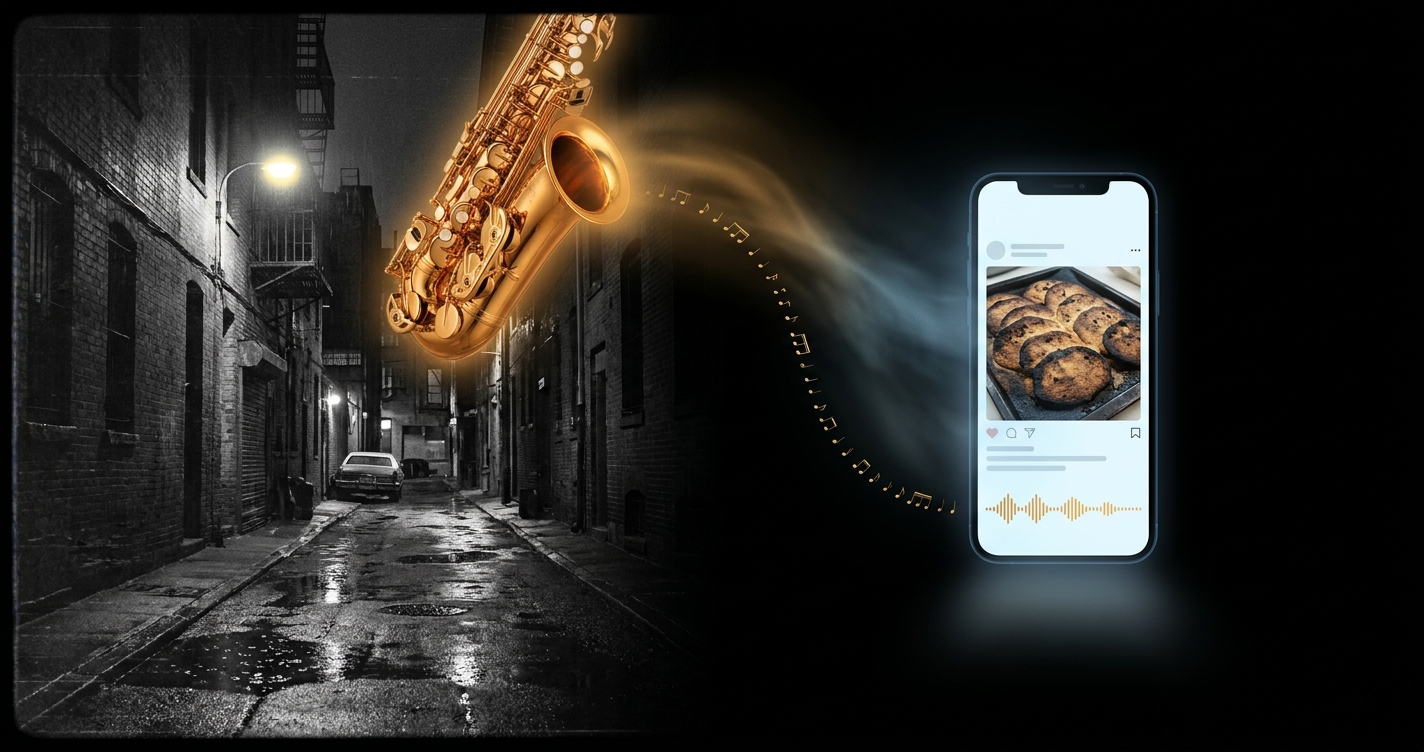
If I never see another video using that saxophone "trending" audio (you know the one), it will be too soon.
Why? Well,
1. Because it has officially become the default background noise of the internet. Every Tom, Dick, and Harry on the timeline is currently using it to score their mundane daily inconveniences. And Tom, Dick and Harry seem to have a lot of inconveniences they’d like to highlight. Hence the incessant sound ripping through my eardrums 24/7. And,
and 2. I don’t think hardly anyone using the track has any earthly idea what they’re listening to. Or more importantly, where it came from.
That haunting saxophone melody isn't a generic, royalty-free "sad vibe" created in a laptop software lab.
It is the climactic, instrumental score composed by Stanley Clarke for John Singleton’s seminal 1991 film, Boyz n the Hood.
It is the exact sonic backdrop to one of the most tragic and foundational moments in Black cinematic history; the scene where Ricky is gunned down in an alley, destroying a family's hope of escaping systemic violence.
It was written to carry the immense, crushing weight of institutional grief, racial trauma, and generational loss.
And yet, that exact piece of historical grief is currently being used to track the fact that Becky accidentally burnt her latest batch of artisanal snickerdoodle Dubai dot cake cookies.
It’s also being used by lifestyle creators to lament a broken nail, a rain-cancelled brunch, or the fact that a trendy designer toy went out of stock.
Welcome to the ultimate endgame of the trend economy: The Contextual Cleansing.
This is what happens when a hyper-extractive, algorithm-driven media ecosystem takes a culturally, historically, and racially significant artifact. Then it strips away its soul, cleanses its origin, and flattens it into an entirely meaningless, disposable digital asset.
The machine doesn't care about memory; it only cares about the loop. It extracts the raw emotional frequency of a Black masterpiece. Divorces it from its reality. And sanitises it so it can be comfortably consumed by a suburban audience as a superficial joke.
It is a form of cultural amnesia, automated by design.
On social media, audio tracks are treated as entirely flat, interchangeable utilities. The user interface actively encourages you to tap the sound, anchor it to your video, and ride the wave of the algorithmic momentum to farm engagement metrics. In that seamless process, any history or meaning is completely erased.
The profound collective pain of a community is flattened into a cheap pattern-interrupter. One that's designed to keep a scrolling thumb lingering on a screen for an extra three seconds.
This goes far deeper than a simple case of online ignorance; because it’s a systemic degradation of how we relate to art and human expression.
When we allow social media trends to completely dilute our historical touchstones, we trade true cultural literacy for a shallow, transactional language of aesthetics.
We stop respecting the origin. We stop honouring the weight of the story. And we begin treating the world's creative legacies as disposable content fodder to be chewed up and spit out by the next fiscal quarter.
For brands, this saturation point carries an immense ethical and strategic warning.
The era of lazy, thoughtless trend-jacking is hitting an absolute wall of consumer cynicism. Audiences are starting to develop an incredibly sharp, protective radar for when a brand or creator is mindlessly using a cultural frequency they haven't earned, don't understand, and can't respect.
Now, on the other hand we have something called Cultural Integrity. In which, we cannot treat art as a flat, un-contextual utility. We must instead strive to have the educational discipline to investigate the origin. Honour the provenance of the work. And understand that some sounds are far too sacred to be used as background music for an unboxing video.
No matter what creative pursuit you engage, take a second to investigate the roots. Respect the weight of the story. And remember that true creative authority isn't about jumping on every passing loop. It’s about possessing the depth to know exactly when to leave a masterpiece completely alone.
-Sophie Randell, Writer