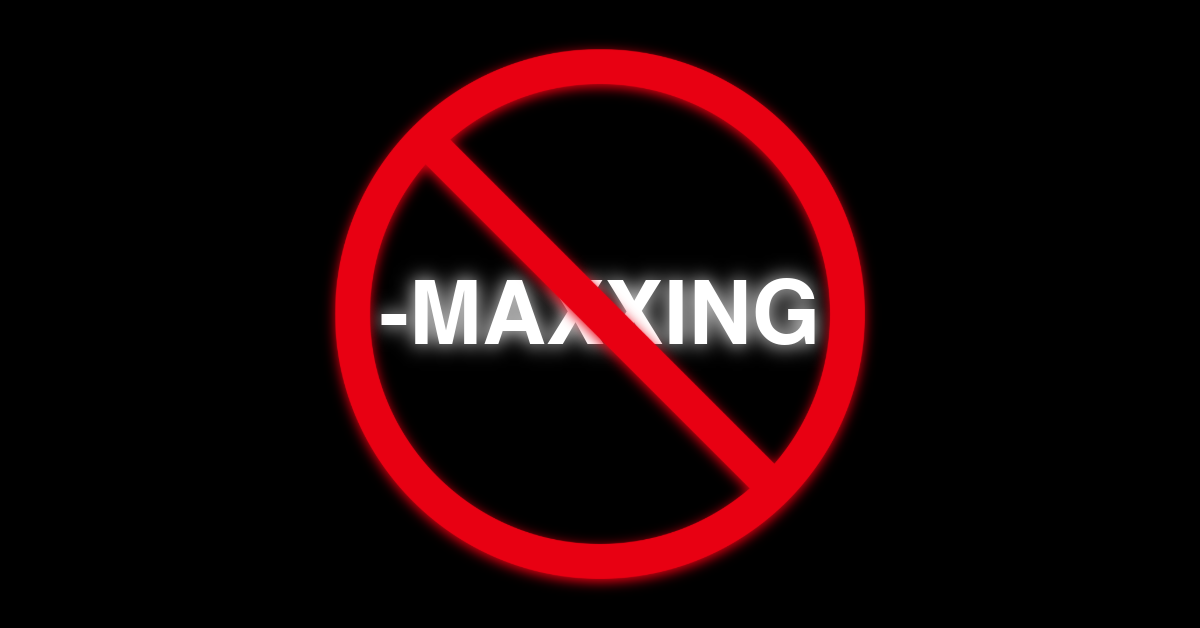
I am begging y’all, please, can we stop turning our hobbies into an equation.
We’re all well acquainted with the internet’s favourite new suffix. We survived the "core-ification" of everything. And it was annoying, sure, but it was fundamentally about vibes. It was an aesthetic thing. Harmless. And then overplayed.
But we have officially graduated from aesthetics to optimisation. What started as looksmaxxing has turned into us -maxxing our lives.
Suddenly, people aren't going for a walk; they are hikemaxxing.
Cutting back on the gin and tonics? Sobermaxxing. I’ve even seen people talk about funmaxxing, which is a phrase so deeply depressing it makes me want to stare into a blank wall.
It is the linguistic successor to the data-driven corporate world, and it has spilled out of Silicon Valley directly into our souls. We have developed an incessant, pathological need to quantify, measure, and score almost every single second of our human existence.
And so, I’ve got to wonder, when we turn living into math, do we take away our actual ability to live? I think you know the answer.
We like to pretend that hyper-quantification is just self-improvement.
We’re simply strapping on our Oura rings, checking our continuous glucose monitors, tracking our screen time, and logging our hydration. But what we are actually doing is gamifying our mortality.
The Organic Life was once: Go for a walk, feel tired, maybe eat a sandwich.
The Quantified Life is now: Hikemaxx, check Zone 2 cardio, review sleep score, optimise.
And optimise. And optimise. And optimise again.
When you are hikemaxxing, are you even looking at the trees?
Or checking your Apple Watch to ensure your heart rate stays precisely in Zone 2. When you are sobermaxxing, are you relaxing and enjoying the subsequent clarity? Or are you logging consecutive days on an app, watching a digital streak grow like a high score in a video game?
We have outsourced our intuition to our hardware. We no longer trust our bodies to tell us if we are tired, happy, or full. We wait for a notification on our phones to validate our physical state.
We are treating our lives like an efficiency problem to be solved.
And the moment an experience becomes a metric, the magic immediately evaporates. You are no longer existing in the present; you are auditing your own performance.
The dark psychology behind quantification culture is a profound fear of wasted time.
In a hyper-capitalist digital landscape, we have been conditioned to believe that any unstructured, unmeasured moment is a failure of productivity.
If a tree falls in the woods and your WHOOP didn't record the caloric burn, did it even happen?
By turning everything into math, we are trying to eliminate the beautiful, messy friction of being alive.
Math is clean. Math has a correct answer. Math gives you a sense of control in a world that feels completely uncontrollable. But I’m terrible at math. And that’s why I know human joy is inherently inefficient.
The best moments of your life cannot be optimised. You cannot "maxmaxx" a spontaneous, deep conversation with a friend that lasts until 3:00 AM. You cannot quantify the feeling of a lazy Sunday afternoon where you do absolutely nothing and feel no guilt about it.
When you strip away the unpredictability, the boredom, and the accidental detours in favour of a perfect data curve, you aren't living. You are just operating your meat-suit.
And you’re better than that, babes. You’re more than a meat suit.
If you work in marketing, branding, or product design, the saturation point of quantification culture is looming.
Consumers are getting exhausted by the constant surveillance of their own data.
It’s me, I’m the f*cking consumer.
The next massive wave of brand loyalty belongs to the brands that give us permission to turn that sh*t off:
- Sell the "analogue detour": Stop marketing your products as tools that make people faster, leaner, or more productive. Start marketing your products as a sanctuary from the metrics. Position your brand as the reason to leave the phone at home, ignore the step count, and embrace the unstructured mess of the present.
- Embrace the "in-efficiency" narrative: Create campaigns that celebrate the beauty of doing things the long way. Celebrate the burnt dinner, the lost trail, the hobby you are completely terrible at but do anyway just because it feels good. Champion the anti-perfectionism movement.
- Design products for pure presence: Look at the massive resurgence of analogue tools, vinyl records, disposable cameras, paper journals. These are practically emotional defence mechanisms at this point. They are products that cannot be updated, tracked, or optimised, and force the user to look at what is right in front of them.
The tongue has a job, and the brain has a calculator. But we need to give them both a rest. We don't need to maxmaxx our existence to prove that our lives have value.
Catch yourself, before you turn a simple human pleasure into a milestone or a metric. I want you to take a deep breath, take off the tracker, and let yourself be completely, beautifully unoptimised.
-Sophie Randell, Writer