Get in loser.
We’re going Hobbymaxxing.
We are no longer using or evenings and weekends to simply rest, consume passive media, or disconnect. We are officially throwing ourselves into physical pursuits with a level of dedication that resembles a second full-time career.
And look, I know. You’re tired. I’m tired. Who has the time? You do. I promise you, we have the time. Because that time is ours. And it’s time to take that time back.
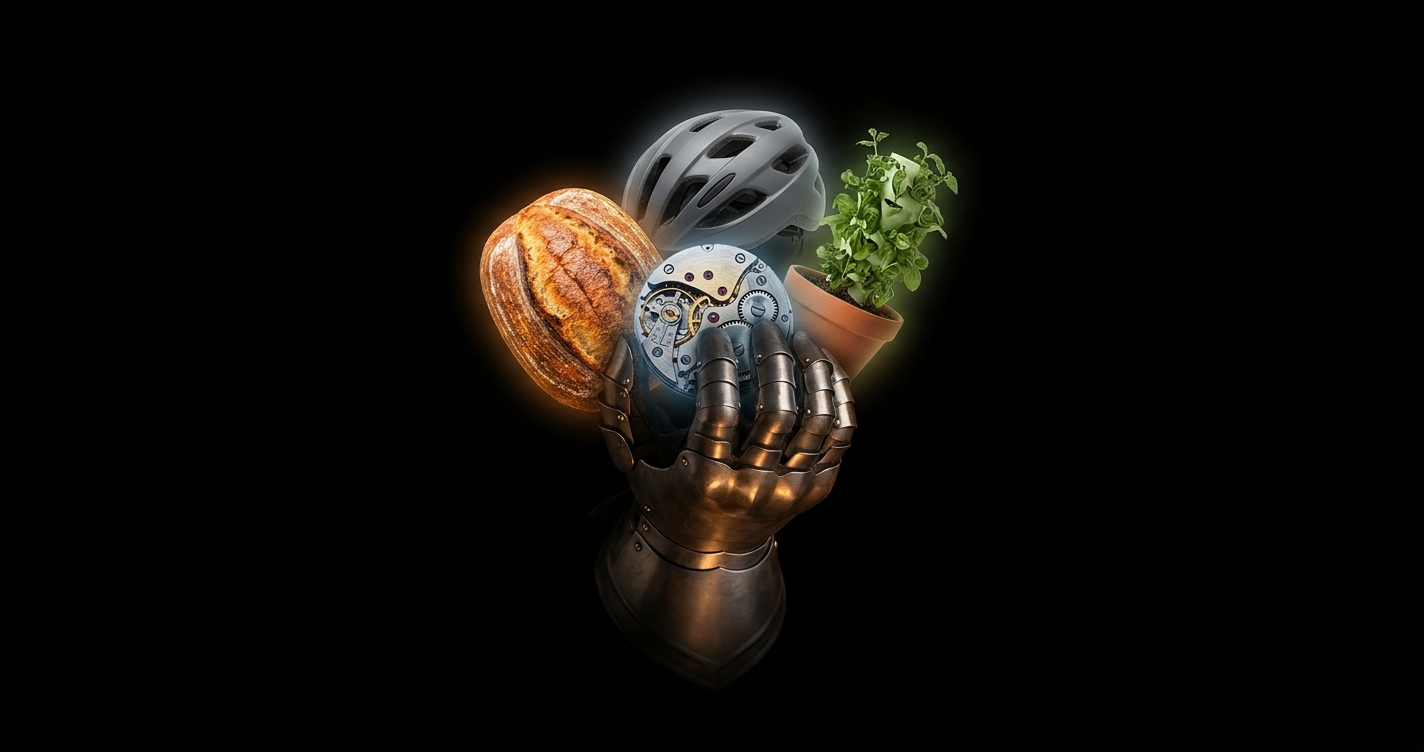
Do you ever stop to think why people are learning the intricate chemistry of sourdough fermentation, spending thousands of dollars on long-distance cycling gear, mastering the ancient mechanics of manual watch restoration, or building insane indoor vertical gardens??
Because we’re tossing out the premise of the casual pastime. We are Hobbymaxxing.
And it’s about to become one of the biggest movements of our generation.
To understand why our generation has turned the concept of a hobby into a high-stakes crusade, you have to look past the superficial lifestyle aesthetics and diagnose the profound existential void of the modern workplace.
For the vast majority of professionals, full-time corporate employment has become an abstract exercise in administrative friction.
We spend our days moving pixels across a screen. Updating management dashboards. Sitting in alignment meetings. And optimising automated workflows. It’s not even real. None of it. Like these jobs didn’t even exist ten years ago.
So, at the end of a forty-hour work week, when we are left with zero tangible, physical proof that our labour actually existed in the real world, how are we supposed to feel?
Our actual day jobs have been systematically stripped of tangible human output. And it's leaving us feeling like hollow, anonymous cogs in a synthetic corporate machine.
Hobbymaxxing is the most logical response to this kind of strange alienation.
It’s some sort of clawback of raw human agency.
When you sit down at a workbench to hand-stitch a piece of raw leather just to make yourself a belt, or when you stand in a kitchen calculating the precise hydration percentage of a flour blend, you are engaging with the hard, uncompromising physics of reality.
The material doesn't care about your corporate hierarchy. It doesn't care about your platform or your algorithms. And it certainly can’t be automated by a generative software model.
If you make a mistake, the leather tears or the bread burns, offering an immediate, honest, and unfiltered feedback loop that modern professional life completely denies us.
We aren't throwing what little energy we have left into these pursuits to simply look productive. This is an act of proving to ourselves that we are still capable of causing a direct, physical effect in the universe. When everything else feels so… uncanny. So, unreal.
The beauty of this counter-movement lies in its radical redefinition of value. For the last decade, hustle culture completely poisoned our leisure time. It convinced us that every single interest, talent, or creative impulse needed to be immediately monetised, turned into a side-gig, or broadcast to a public social media feed for external validation.
Hobbymaxxing pulls us away from that extractive trap by restoring the sacred boundary of the un-monetised pursuit.
It takes us back to the way things should be. Spending twenty hours building a technical skill simply because it brings your brain a sense of deep, internal fulfilment is defiance. And it's unapologetic defiance at that. Because it removes the currency of corporate tracking metrics, replacing it with the ultimate luxury asset: self-directed mastery.
This shift represents a massive structural relocation of consumer identity.
Slowly, modern professionals are rejecting the notion of defining who they are by the corporate title on their email signature or the logo of the company they work for.
Instead, they're anchoring their true identity to their hobbies.
If your brand communication is still trying to appeal to consumers through lazy, generic corporate archetypes or superficial lifestyle status symbols, you are completely missing the cultural mark.
This next wave will belong to the businesses that understand how to validate, equip, and honour the hobbyist’s obsession. Businesses treating their consumer base not as passive spenders, but as dedicated, highly literate creators who respect texture, provenance, and detail.
The open web can keep screaming for our data, our hyper-productivity, and our constant compliance inside the digital panopticon.
So as a consumer, stop letting the market convince you that your worth is entirely tied to the efficiency of your digital output or the size of your corporate invoice. Put down the device and pick up a freaking tool.
Go for a run or climb a freaking mountain. Allow yourself the joy of building something real with your own two hands, or feet, entirely on your own terms.
This world is desperately trying to automate our souls. You need to understand that the real display of personal authority will never be climbing a ladder you don't own. It will be having the creative guts to become the master of your own craft.
Even if it means sewing a sh*tty top, or making a belt you could never sell. At least you made it. And at least it’s yours.
-Sophie Randell, Writer