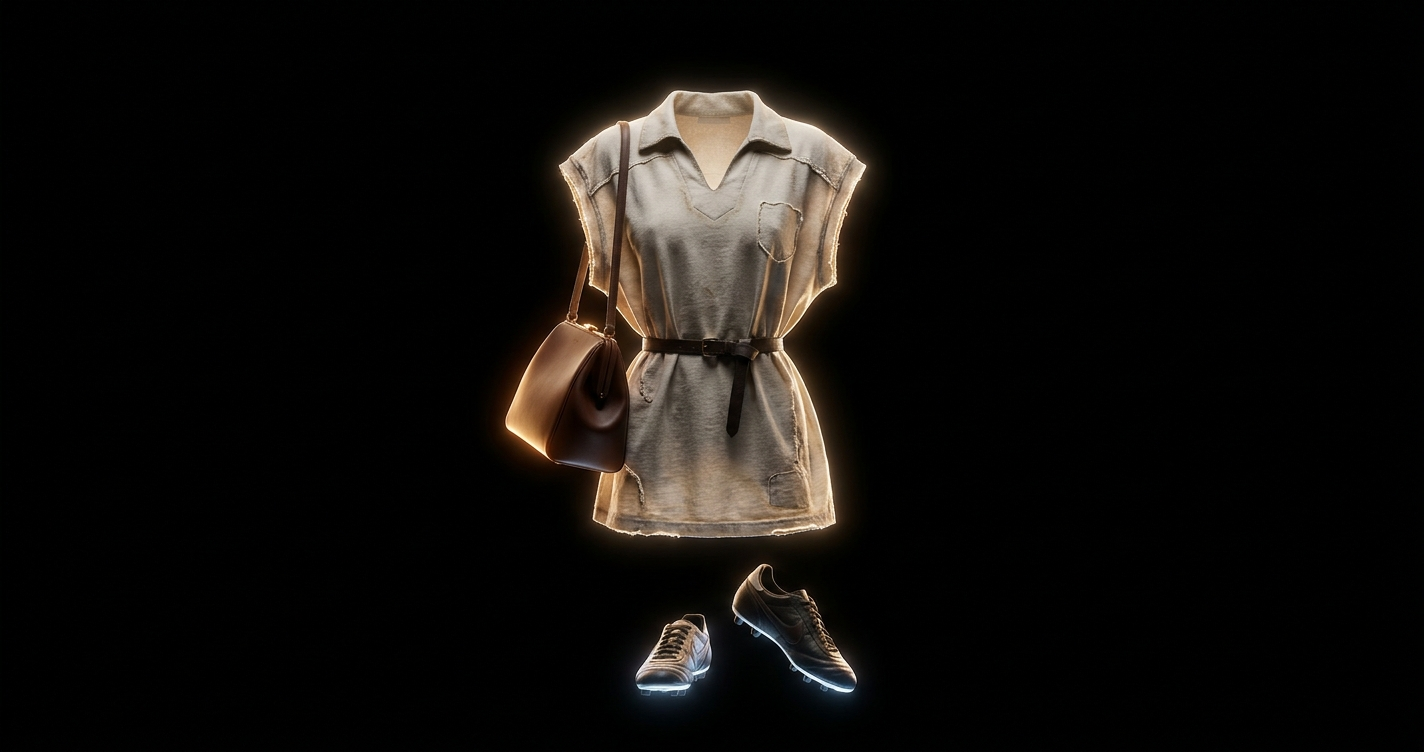
If I were to take a shot every time I saw an elite internet IT-girl wearing a bootleg, oversized customised vintage football jersey this week, I would be horizontal under the table quicker than I could say "bend it like Beckham".
If you haven’t noticed, the fashion crowd has totally clocked in to the football world. And the transformation is both so hot, and a phenomenon worth talking about.
Look at how low-profile, terrace-culture sneakers have been dominating the sidewalk (yes, for a while, now). Footwear silhouettes are becoming increasingly football-esque with cleat-inspired details. Club kits are being paired with luxury tailoring on the streets of Milan and Paris.
All of your fave influencers and fashion girlies are currently posting in the customised, cinched-waist jersey of your dreams. If you’re wondering why, it’s because football has found itself front and centre of the cultural and fashion realm.
And it's operating as a massive, ubiquitous lifestyle statement. Mind you, for a demographic that has likely never watched a full ninety minutes of a match in their lives.
Does this go deeper than a superficial, seasonal trend cycle?
Maybe. What we are witnessing may just be the algorithmic unmooring of sports subculture from the actual sport itself.
Historically, wearing a football shirt was an act of localised, tribal loyalty. It was a visual contract that said you stood by a specific community, a specific city, or a specific set of working-class roots.
The modern interest-based feed has completely hollowed out that contract. It's stripped away the geographical and athletic context to turn the football kit into a pure design canvas. The jersey has lowkey been liberated from the stadium and repurposed as the ultimate vehicle for effortless, gender-fluid street style.
The genius of this shift lies in its relationship with authenticity.
For the last few years, the fashion landscape was utterly suffocated by the "clean girl" aesthetic and hyper-minimalist corporate luxury. (I know, I harp on about this all the time, but stay with me.) It was an aesthetic built on absolute restriction, pristine whites, and looking like you spent your day inside a sanitised wellness clinic.
The football “baddie” fashion wave, frequently dubbed ‘Blokecore’, is the perfect antidote we've all been desperate for.
A vintage kit carries an inherent, gritty texture. It screams heritage, friction, and real-world utility that allows the wearer to borrow the deep, romantic history of a sports institution.
All without having to endure the actual heartbreak of supporting it. You don't need to know the offside rule to appreciate the typography of a 1994 sponsor logo or the beautiful, high-contrast palette of a retro away kit. You just have to look hot wearing it.
This has triggered a massive, high-velocity commercial boom.
High-fashion houses have always observed sports culture from a safe distance, and dabbled when necessary, of course. The two go hand in hand. But they are now actively colonising it through luxury collaborations, custom bootlegs, and high-end runway reinterpretations.
The sneaker market has been almost completely reshaped by this terrace-style infiltration. And it's forcing brands to pivot their manufacturing pipelines away from chunkier dad-shoes and toward slim, low-profile, indoor-football silhouettes (hello, Adidas anything right now) that look just as natural under a silk slip dress as they do on a pitch.
The jersey has become the ultimate equaliser. A democratic piece of sportswear elevated to a high-luxury premium simply by changing the styling context.
I guess what I’m trying to say is, the commercial takeaway is a great fkn lesson in subcultural liquidity.
Stop trying to market your products inside static, isolated vertical boxes.
Rigid demographic definitions are kind of played out. Brands that understand how to cross-pollinate, taking the raw, emotional energy of one world, a poignant one, like the fierce loyalty of sports fans right now, and translating it into the visual aesthetics of another, are the ones on the money.
If your brand communication feels too literal or too buttoned-up, you risk being left out of the conversation entirely.
For someone who has studied both fashion and pop culture my entire career, this shift feels incredibly symbolic. The traditional rules of who gets to play in which arena have been dismantled. The gates are open, the aesthetics are fluid, and the old corporate boundaries are melting away.
And for the record, you don’t need permission from the establishment to change the game or a freaking traditional badge to claim your authority.
And you certainly don't need to stay in your lane to win the crowd.
This phenomenon is a great reminder that the most exciting culture is always created when you have the creative audacity to break the rules.
And if you do need permission, you have mine. Break the rules, baby.
-Sophie Randell, Writer