As our work and play become increasingly automated, a wave of burnout is hitting the software ecosystem.
Because we are all so fucking fatigued by stiff templates that force our creative thinking into corporate-approved boxes.
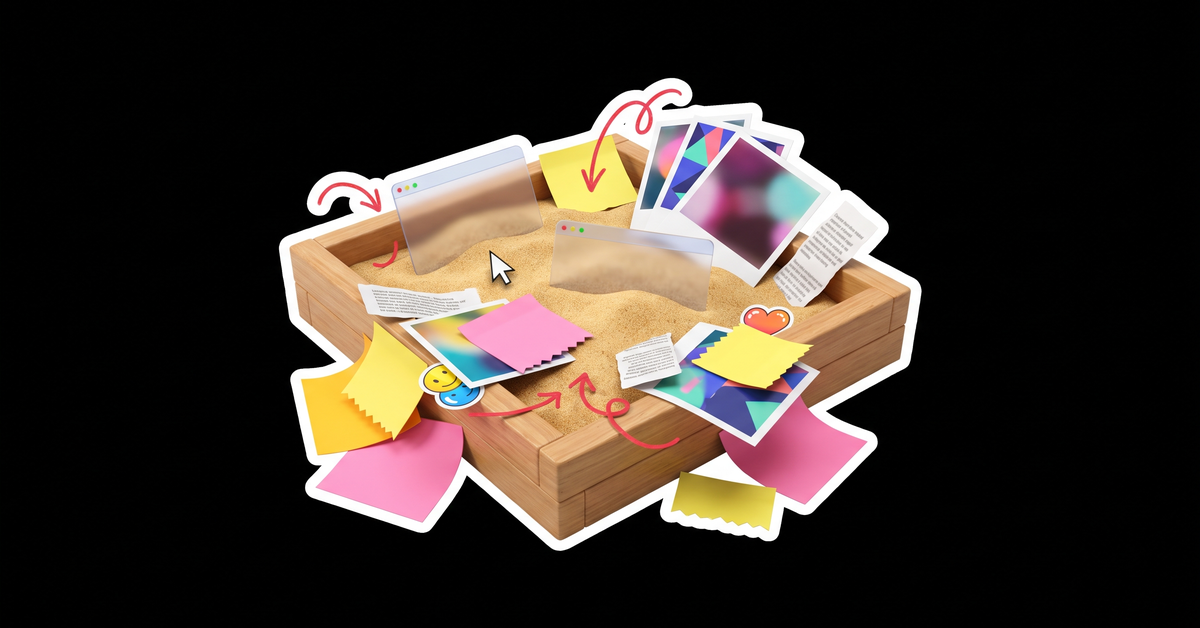
This is what I like to call: the rise of the Digital Sandbox.
Because we’re all just lab rats in a maze. Y’all may as well make the maze entertaining.
And by maze, I mean modern professionals are increasingly opting for “Sandbox” software; spatial canvas tools and open-ended platforms where they can reject standard templates, and instead choose to construct textured workspaces that are the furthest thing from a spreadsheet and look more like a multi-layered digital scrapbook.
The Search for Spatial Agency
This shift isn’t just about people wanting a prettier place to type notes.
It’s a reaction to the loss of human agency in a world driven by predictive algorithms. When a software tool feels too automated, it actually suffocates the creative process.
Modern knowledge workers and creatives want to play inside their tools. We crave spatial environments where we can organise information based on our unique non-linear logic, rather than a pre-made template.
Look no further than how teams are weaponising platforms like Miro and Figma. Originally built for rigid wireframing and product mapping, these open-canvas tools are now used as digital war rooms where stickers, loose text fragments, overlapping images, and hand-drawn arrows live in beautiful, disorganised harmony.
Similarly, consider the cult-like devotion surrounding Notion. The platform’s core appeal stems from its absence of structure. A user can spend hours building a dashboard from scratch, blending database blocks with aesthetic GIFs, personal journal snippets, and customised layouts. It becomes a reflection of their mind, flaws and all.
Even in the newer wave of software architecture, tools like the spatial note-taking app Cosma are thriving because they allow users to visualise their thoughts as a constellation of interconnected data points, rejecting the traditional folder-and-file hierarchy entirely.
From Frictionless Pipelines to Creative Sandboxes
For brand architects, product designers, and marketers, this sandbox renaissance marks a critical turning point in how we design customer experiences.
For years, the golden rule of onboarding was to map out a hand-held journey that guided users from step one to step ten with no deviations, assuming that giving a user total freedom would lead to cognitive paralysis.
But in a saturated market where everything feels identical, that hand-holding can feel claustrophobic. If your digital touchpoint or user onboarding pipeline doesn’t allow for personal expression, modification, or a bit of healthy chaos, the modern user will simply close the tab.
This doesn’t mean you abandon clear UX design or force your audience to figure things out in the dark. Rather, it means introducing intentional “sandbox zones” into your ecosystem. It means giving your users the high-fidelity building blocks of your brand and allowing them the autonomy to assemble, manipulate, and play with the pieces to fit their specific realities. When a consumer can physically shape their own relationship with your interface or product, their sense of emotional ownership over that brand skyrockets.
The Takeaway:
Review your digital product design, your onboarding flows, and your brand touchpoints. Strip away the restrictive templates, introduce open-ended canvas elements, and give your community permission to play.
In a landscape filled with sterile, pre-made digital boxes, the brand that offers a raw sandbox for human creativity will always win the deepest customer equity.