I am currently one week into a self-imposed ten-week challenge.
And I need to tell you (trauma dump) why I’m doing it. Because whenever I hear “challenge” I think of some gross self-optimisation course that an unqualified influencer has sold you for way too many USD.
This is not that. I promise you I am the last one to get caught up in the sterile world of modern lifestyle optimisation.
The guidelines I’ve drawn up for myself are simple. Zero refined sugar. A strict maximum of three alcoholic drinks per week. A mandatory daily mindfulness practice. Training six days a week. And, the most important, a drastic, non-negotiable reduction in screen time.
I’ll admit, onpaper it kind of does look like the exact kind of militant productivity theatre I usually rip to pieces right in this very newsletter.
And it maaaaybe sounds like I’ve accidentally fallen down a Silicon Valley biohacking rabbit hole or some sh*t.
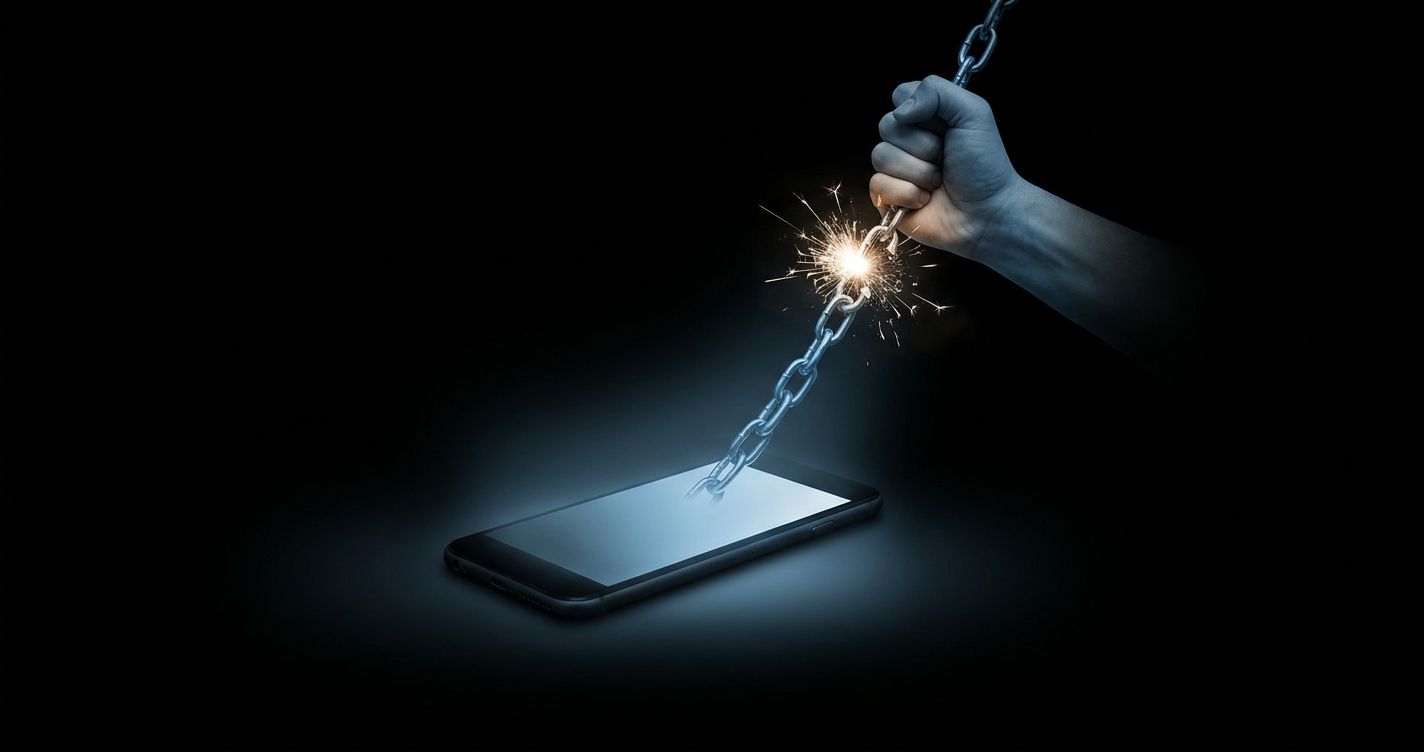
But I haven’t. Because the reality of this challenge is simply an act of war against my own addictions, specifically the one sitting right in the palm of my hand.
Doing this job for a living, spending my days analysing internet trends, dissecting cultural shifts, and monitoring the velocity of public attention has forced me to confront a deeply uncomfortable truth about my own behaviour.
I have spent years hiding behind the cosy, stylised label of being "chronically online".
Treating my constant presence on the feed as a necessary professional hazard or a quirky personality trait.
But y’all, as I looked at my weekly screen-time metrics recently, the delusion evaporated and I realised am not chronically online. I am not a hyper-connected digital native navigating a modern workspace.
I am desperately addicted to my f*cking phone.
The realisation that an inert piece of glass and metal has successfully seized the monopoly on my working memory, my focus, and my passive boredom is what triggered this entire ten-week horizon.
I didn't design this protocol because I want to maximise my corporate synergy or turn my physical body into an optimised, frictionless machine for a data-tracking dashboard.
I did it because I genuinely want to, need to, lock in and reclaim my basic human agency.
I am tired of outsourcing my attention span to an interest-based feed. A feed that wants to monetise my cognitive exhaustion. Instead, I want a stark, high-friction boundary to remind myself what it feels like to possess a quiet and unmonitored brain.
But entering this challenge has sparked a fascinating stream of thought regarding how we approach self-improvement in a hyper-connected society. I had to stop and ask myself why on earth I felt the need to construct a formal, titled ten-week challenge just to sort my basic sh*t out.
Why has our collective psychology become so fragmented that we require a structured, named entity to give ourselves permission to drink less alcohol, move our bodies, and touch grass?
The answer lies in how completely the wellness industry has colonised our self-worth. We have been conditioned to believe that personal growth only counts if we adhere to some pre-packaged, rigid internet protocol like 75 Hard. A militant, unforgiving routine that feels less like a path to health and more like a corporate compliance audit designed to make you want to cry.
We’ve taken the concept of improvement and hijacked it with the language of software engineering. If you aren't tracking your macros on an app, measuring your sleep quality with a smart ring, or following a strict, punishing regimen that makes you want to cry, scream and throw up simultaneously, authored by an (unqualified) online fitness guru, the market tells you that your effort is invalid.
This is the lie that the optimisation era tells us.
Improving your life doesn’t need to look like an awful, clinical, and disciplinary sentence. You don’t need to ask an online subculture for a pre-written rulebook to reclaim your health. The most optimal thing you can actually do is completely ignore the internet's templates and author your own protocol, exactly as I have done here.
If your challenge means eating a specific way but keeping your morning sleep-in, or cutting out social media while allowing yourself to read fiction for three hours a day, then that is your sovereign right.
You can choose to harden your edges and sharpen your focus without turning your daily existence into a sterile, joyless performance of perfection.
Personal sovereignty isn't about achieving a state of flawless compliance to an external ideal. Instead, it's about having the confidence to look at the parts of your life that are feeling soft, distracted, or controlled by outside forces.
Then deciding to build your own scaffolding to fix them on your own terms.
We don't need to feed the data-tracking machine or announce our milestones to an invisible audience to prove we are making progress.
Just set the boundaries, touch the grass, be a little bored even.
The power is yours, dear friend. Now wish me luck as I try to take mine back x
-Sophie Randell, Writer