I stood in the middle of a supermarket aisle yesterday morning, looked down at the most basic basket of everyday needs; milk, tampons, toothpaste, mince, and felt a genuine urge to cry over the total.
This is not a bit for an article. I seriously felt both upset, and ill at the same time.
It’s a crisis that millions of humans experience every single week. A sudden, sharp panic over the fact that meeting basic human survival needs has become a financial obstacle course. The standard response from mainstream media and political commentators is always to blame immediate, temporary variables. Seasonal inflation or supply chain disruptions.
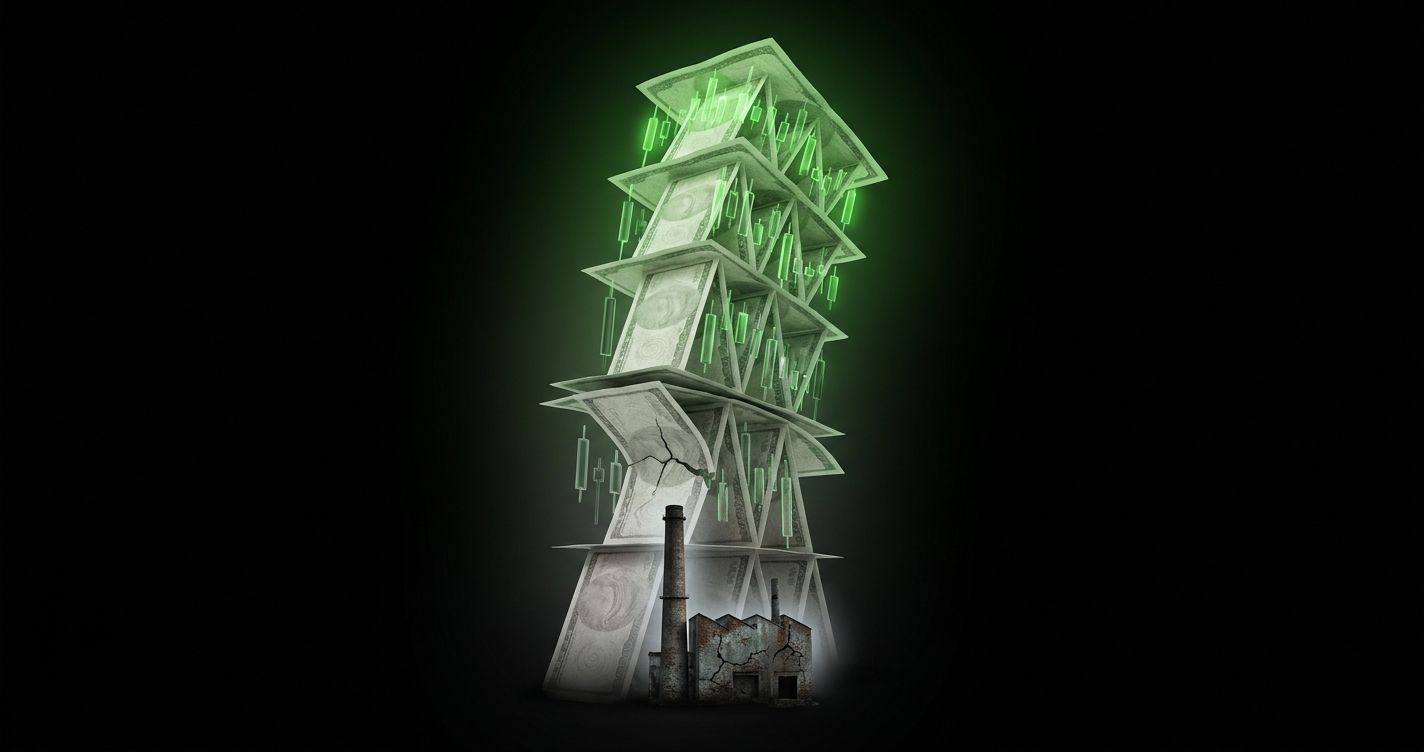
But if you look past the superficial political theatre and listen to the structural undercurrents of global finance, a potential reality emerges: the downfall of the Western economic empire.
And it won't be caused by a secret cabal, a foreign adversary, or a shift in the party line, but by mathematics.
We live inside the volatile endgame of what economists call the Fictitious Economy. To understand how we arrived at a point where the once-prosperous middle class is struggling to buy butter, you have to trace the multi-decade cannibalisation of our physical infrastructure.
In the immediate post-World War II era, the Western economy was an unmatched weapon of mass production. Holding a near-monopoly on global manufacturing, it formed the rock-solid bedrock of a thriving middle class. One where a single, stable income could comfortably support a family, secure a home, and build generational equity.
The economy was tethered to the physical world like steel, factories, agriculture, and tangible exports.
Then came the 1970s, and the system discovered a much faster, lazier way to generate wealth: the leveraged buyout.
This aggressive manoeuvre of acquiring real companies using massive amounts of borrowed money spawned the modern monster known as Private Equity.
This entire industry doesn't make money based on what a factory produces or how well a farm grows; it makes money based on Assets Under Management. The bigger your portfolio, the higher your corporate fees, creating an unyielding incentive for rapid financial expansion over actual physical production.
To fuel this mass financialisation, the corporate machine systematically outsourced physical manufacturing to cheap labour countries like China.
This created two parallel, highly unequal economic universes: the tangible and the intangible.
The real economy of physical goods was instantly dwarfed by a massive, speculative financial superstructure. Something built entirely on paper valuations, debt packages, and transactional algorithms.
Over the last twenty years, the consequences of this neglect have become extremely visible. Half the companies on the major stock markets have quietly disappeared. Usable farmland has shrunk by a fifth. And traditional manufacturing jobs have been rendered almost redundant.
But don't worry. The financial television networks scream at us every single morning. Because the value of our digital assets has absolutely exploded!!
This is an unprecedented concentration of wealth, where an ever-shrinking group of transnational corporatists is creating the world's very first trillionaire.
The modern economy has transformed into a high-stakes gambling bazaar. But the terrifying truth very few executives are willing to admit is that the house is starting to lose its grip too.
Current stock market returns are being single-handedly driven by wild, unstable AI speculation. The fastest-growing, highest-valued businesses on the planet are completely disconnected from the production of real goods, factories, farms, or exports. We are cannibalising our own foundations to fund a digital casino.
History proves a brutal sociological law: uprisings and systemic collapses don't happen when conditions are at their absolute worst.
They happen when things suddenly and violently worsen after a period of relative expectation.
The corporate machine has spent decades convincing the middle class that paper wealth and digital optimisation would trick the laws of physics forever. But you cannot eat a data pipeline, and you cannot build a stable society out of leveraged debt.
When the current AI speculation bubble inevitably pops, the collision with physical reality is going to be... well, I’ll leave that to your imagination.
What do you think?
-Sophie Randell, Writer