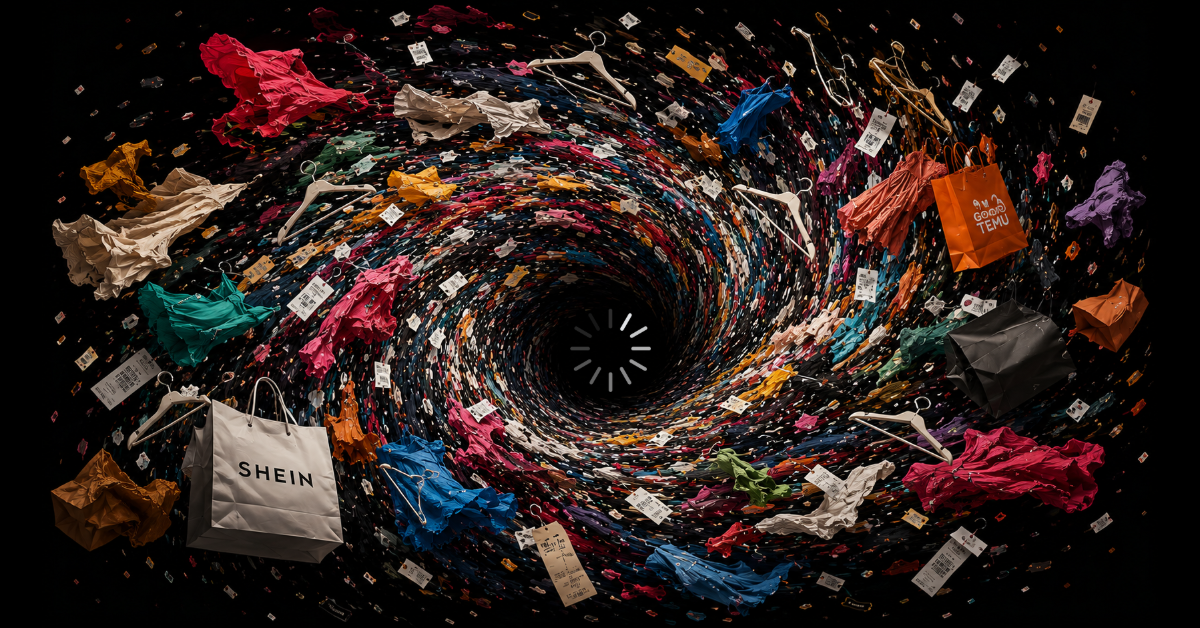
I can’t believe that in 2026, I’m still looking at f*cking Shien hauls on TikTok.
Every time I see a creator holding up a sh*tty little top made entirely out of plastic and squeal abut how cute it is, all I hear is the ultimate eulogy for consumer culture. We used to talk about fast fashion as a supply chain problem; cheap factories, copied runway designs, and a three-week turnaround.
But over the last couple of years, the model absolutely accelerated. And then it completely broke away from reality.
With the rise of ultra-fast fashion giants like Shein and Temu, we are no longer dealing with a retail industry. Instead, it's an attention-devouring algorithmic machine that has successfully turned physical garments into disposable digital content garbage. And the timeline is filling up as quick as the landfill with this sh*t.
To understand how grim this has gotten, you have to look at the terrifying scale of the math.
- Traditional retail legacy brands launch a few thousand styles a year.
- Zara, the original pioneer of fast fashion, pushed the boundaries by dropping around 10,000 to 12,000 styles annually.
- Shein? They dump an astronomical 1.3 million distinct styles into their ecosystem every single year. Sometimes, 10,000 styles A DAY.
This isn't fashion, babes.
It’s a monster. A high-frequency trading algorithm operating in a textile warehouse.
These platforms don't hire human trend forecasters to anticipate culture.
Instead, their software scrapers crawl social media feeds, search data, and competitor sites in real time. Then they instantly turn this data into automated design specs.
The physical item doesn't even exist when it’s uploaded to the app. They post a digital rendering, then track consumer engagement and click-through metrics. If the data spikes, a fully-automated factory management system instantly commands a small subcontractor to pump out a micro-batch of 50 units.
Like… it’s disturbing and alarming af.
If it sells, the loop scales. If it doesn't, it’s discarded. It is a hyper-reactive feedback loop that completely removes the human element from production.
The marketing brilliance of this model (and its deep cynicism) lies in how it exploits our current cultural exhaustion.
We live in a hyper-fragmented, high-anxiety digital landscape. To say that the collective attention span has been completely obliterated would be an understatement.
In this environment, long-term fulfilment is expensive and difficult. But the fleeting dopamine hit of a “purchase confirmed" screen costs less than a fast-food meal.
Ultra-fast fashion brands build loyalty by engineering an atmosphere of endless, frantic novelty. They weaponised social media dupe culture, explicitly training an entire generation to treat physical clothing as a temporary prop for a single TikTok video or Instagram slide.
I mean, the clothing isn't designed to survive a freaking washing machine.
It is literally designed to survive a single photo shoot or night out and that is it.
Boom. Threads are undone, fraying has begun, and it’s so stretched out of shape you're not even sure if it was supposed to be a top in the first place. Maybe you got it wrong. Because it looks like it’s more suited for that of a small dog now.
By treating physical items like ephemeral bits of data, consumers are entirely shielded from the structural violence required to make an $8 dress possible. When a shirt costs less than a coffee, the math isn’t mathing. But no one’s thinking about the fact that the debt is simply transferred elsewhere.
Where? Well. It is absorbed by underpaid, underage, unregulated subcontractors working 18-hour days for cents per garment. And it is deposited into massive, toxic textile landfills across the Global South.
For years, the marketing ecosystem comforted itself with the rise of "slow fashion" and the Direct-to-Consumer (DTC) revolution.
We were told that radical transparency, ethical sourcing, and conscious consumerism would save us.
What a beautifully naive lie that turned out to be.
The market reality of 2026 has proven that you cannot ethically compete with an apex predator that pays zero data or labour costs. The slow-fashion alternatives have either financially collapsed, alienated their audience with spiralling costs, or been aggressively acquired by the very conglomerates they set out to disrupt.
The corporate machine simply co-opted the language of sustainability. It's turned "Net Zero" targets into unfunded mandates pushed onto desperate Asian factories. Meanwhile, the Changing Markets Foundation notes that roughly 59% of corporate green claims remain completely misleading.
As marketers, the ultra-fast fashion boom presents a harsh, uncomfortable mirror.
It proves that unrestrained optimisation, high-volume automation, and hyper-targeted dopamine loops will triumph over brand purpose and consumer ethics every single day.
These platforms achieved unprecedented growth by giving people exactly what their worst impulses desired: infinite variety, instant gratification, and absolutely zero personal accountability.
They turned the physical world into an extension of the scrollable feed.
The real question isn't whether this exploitative model has gotten worse, because it obviously has. The question is whether we, as creators and consumers of attention, possess the collective willpower to unplug from a machine that demands we treat the tangible world as entirely disposable.
Look, we’re all guilty of having done it at some point. But please, I beg of you, next time you find yourself casually scrolling a feed of ultra-cheap pieces, just remember: You aren’t shopping a sale. You’re feeding a digital void that consumes human labour and spits out landfill content.
-Sophie Randell, Writer