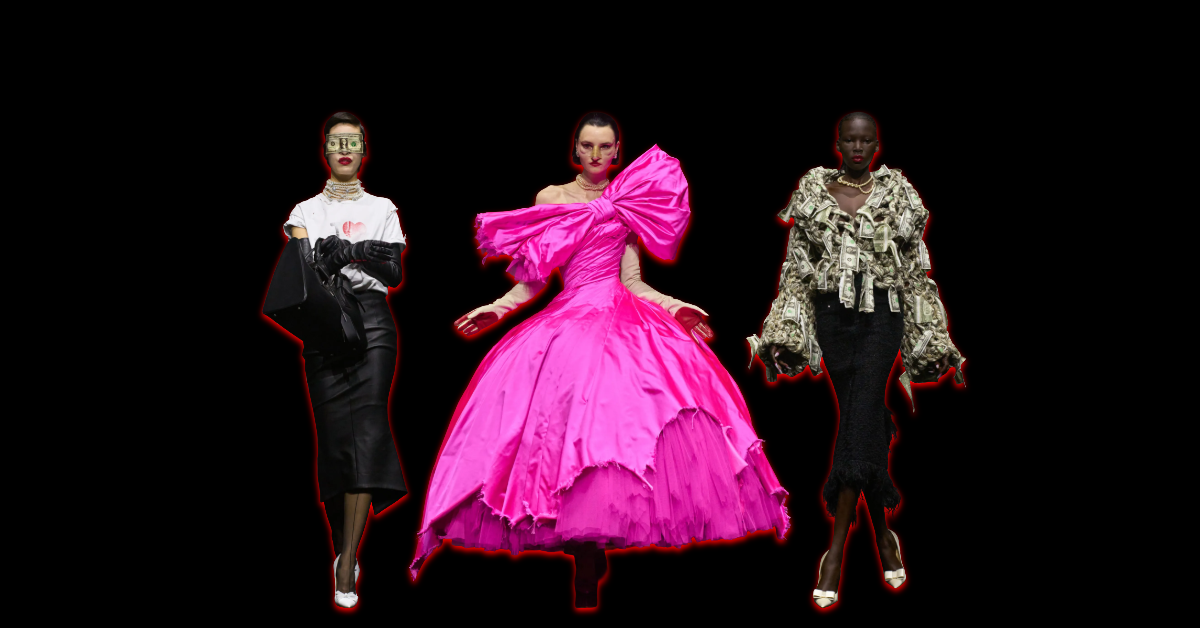
If you were on social media during Paris Fashion Week, you likely caught clips of Matières Fécales’ (Fecal Matter) Autumn/Winter 2026 runway collection, aptly titled “The One Percent.”
The internet devoured it instantly.
It was a digital circus of the grotesque: models draped in distorted, surgery-gone-wrong aesthetics, strutting with pearl necklaces styled as ball-gags and dollar-sign masks obscuring their eyes. Body horror for the runway that was, seemingly, a critique of the billionaire’s playground that is Paris Fashion Week.
Of course, the initial reaction was a collective, cathartic cheer.
In a cultural landscape exhausted by late-stage capitalism and worsening global food insecurity, unreachable beauty standards and terrifying world leaders edging us closer to WW3, the collection was widely received as a bold, sort of punk-rock middle finger to the ultrarich.
On paper, designers Hannah Rose Dalton and Steven Raj Bhaskaran delivered exactly what the internet wanted: a "visual manifesto" mocking the blindness, corruption, and distorted reality of extreme wealth.
But if you stop your analysis there, at the surface level, you miss the real joke entirely.
When a multi-thousand-dollar collection critiques the elite on the official Paris Fashion Week schedule, backed by institutional power houses like Dover Street Market, the medium, in my opinion, actively reverses the message.
The designers have described the collection’s structure as an exploration of power. In interviews, they note that the collection moves from the "power of archetypes" (classic 1950s silhouettes) to the "power of community.”
Bhaskaran explained "When I walk on the street looking like this... we kind of become the 1% in the bus or in the metro... so we wanted to talk about how that is also a form of power.”
And I love that ethos.
But this is also where the cracks in the revolutionary facade begin to show.
Walking the metro in avant-garde makeup is a subcultural flex, not economic power. By equating subcultural capital with systemic wealth, the collection commits a massive act of deflection. When the elite buy into this aesthetic, do you think they’re funding a rebellion? No. They are cosplaying the very rage of the masses who are locked outside the venue gates.
This isn't the first time fashion has pulled this trick. We watched the exact same mechanism play out when Balenciaga successfully sold a "trash bag" pouch for thousands of dollars.
It relies entirely on ironic consumption.
The brand winks to the upper percentile consumer: "We both know this is a ridiculous critique of wealth. But buying it proves you possess enough wealth to treat the critique as a luxury asset."
By inviting longevity-obsessed tech-billionaire Bryan Johnson to walk their runway, Matières Fécales explicitly welcomed the actual 1% into the performance. For the ultrarich consumer, buying a piece from "The One Percent" functions as an expensive moral shield. They get to think, "I can't possibly be part of the corrupt elite because I am wearing the art that mocks the corrupt elite."
I guess my question is; who is Matières Fécales actually mocking?
It clearly isn't the billionaire front row.
The true target of this satire is the general public. The joke is our own collective naivety, the belief that luxury couture can ever be a viable vehicle for systemic economic takedowns.
When anti-capitalist critique is packaged as an exclusive commodity, real working-class anger is safely neutralised. It is transformed from a threat to the establishment into a seasonal, aesthetic trend. The rich don’t need to dodge the metaphorical guillotine when they can buy it, put a designer logo on it, and sell tickets to watch it drop.
From a pure marketing standpoint, "The One Percent" collection is a lesson in subversive brand positioning.
It exploits the ultimate rule of modern consumer psychology: in a world starved for authenticity, anti-marketing works f*cking wonders. By staging a performance that aggressively crunches the boundaries of luxury, Matières Fécales engineered a hyper-exclusive community without alienating their consumers. It’s a win win.
This strategy relies on three brilliant marketing levers:
- The illusion of insider status: luxury marketing used to sell status through perfection. Today, it sells status through irony. By inviting the actual 1% to purchase clothing that mocks them, the brand creates an intellectual gated community. The consumer is then buying the social currency of "getting the joke."
- Algorithmic outrage farming: the grotesque silhouettes and dollar-sign masks are perfectly optimised for shock-value shareability. The brand weaponises working-class outrage to generate millions of dollars in earned media value. The internet’s anger becomes free advertising. This, in turn, drives up the cultural capital, and price tag, of the pieces for the wealthy elite.
- Commodifying the counter-culture: this is the corporate co-optation of rebellion at its finest. By turning systemic economic violence into a seasonal aesthetic, the brand successfully positions luxury goods as "edgy" and "revolutionary." It allows multi-millionaires to consume the aesthetics of the underground, completely insulated from the financial precarity of the people who actually live there.
Ultimately, you may think Matières Fécales is breaking the system; in reality, they are optimising it.
They’ve proven that in late-stage capitalism, you don't need to fix societal rage. You just need to figure out how to invoice the 1% for it.
-Sophie Randell, Writer