
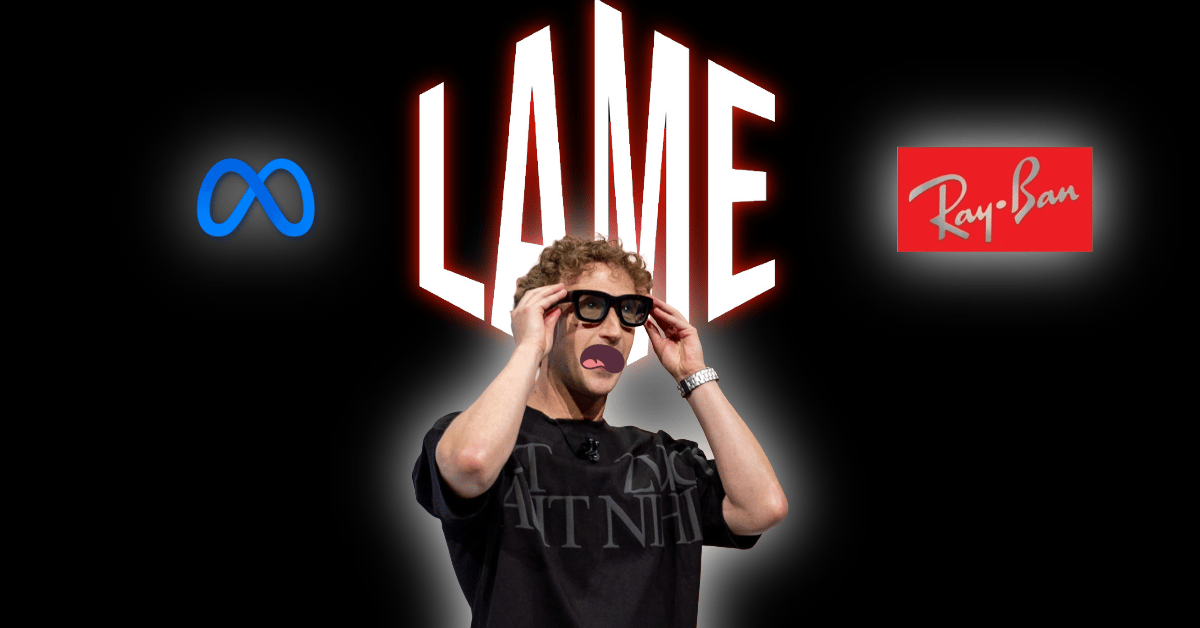
Those are actually cool.
This one comment perfectly sums up the collective ick around Meta's AI-powered Ray-Ban glasses.
Once a timeless symbol of rebellion and style (James Dean, Audrey Hepburn, The Blues Brothers), Ray-Bans now conjure up the image of a guy silently filming you in a café.
The collaboration with Meta was supposed to fuse fashion and innovation.
Instead, it fused two very different reputations: cool and outright fkn creepy. Because when you partner with a company like Meta, you're not just borrowing their technology. You're borrowing their baggage. And Meta's baggage is heavy af.
Data scandals, privacy lawsuits, and a CEO who once described users as "dumb f***s" for trusting him. The same CEO who, in a recent earnings call, said that in the future, people without smart glasses will be at a "pretty significant cognitive disadvantage." Translation: if you're not wearing a camera on your face, you're basically a dinosaur. A slow one. With learning disabilities.
Not exactly a great sales pitch for the privacy-conscious among us.
So, it's no surprise Ray-Ban is experiencing a somewhat "collapse of coolness."
Ray-Ban built its reputation on timelessness. They were sunglasses that looked good on everyone, in any decade, with zero effort. They were shorthand for confidence, rebellion, and taste. But now, thanks to Meta, they've become shorthand for surveillance.
The vibe shift is real. The moment a brand like Meta touches something, it stops being chic and starts being... unsettling.
No matter how sleek the design or how subtle the camera, you can't separate the product from the company that powers it. And in Meta's case, that means you can't separate the innovation from the history of exploitation.
You can almost hear the collective sigh online amongst forums and articles.
Brand partnerships used to be about shared aesthetics and market expansion.
Today, they're about shared ethics. Consumers often don't just purchase a product. They're buying into the values behind it. Which means that when Ray-Ban teamed up with Meta, it merged trust issues.
We've officially reached a point where reputation functions like second-hand smoke-you don't even have to light it to get poisoned by proximity.
And this isn't just about bad optics (pun intended).
These glasses are part of a much bigger shift: the normalisation of wearable surveillance.
We already live in a world where every digital step leaves a footprint. Our phones track our movements, our conversations are mined for ad data, and our faces unlock everything from bank apps to airport gates. But now, with cameras that can record anyone, anywhere, without consent, we've crossed into a new, eerily casual phase of surveillance.
The examples are disturbing:
A woman noticed her aesthetician wearing the glasses during a Brazilian waxing appointment.
A Border Patrol agent was spotted using them during an immigration raid.
Two college students hacked the glasses to dox strangers using facial recognition.
Most recently, people used them to film and harass massage parlour workers for online clout.
Meta's response? An etiquette guide that basically says, "Don't be a jerk" and a tiny LED light that's supposed to indicate recording. The same kind of light that's easily covered with a sticker, or worse, disabled with a $60 mod.
It's the corporate equivalent of saying "We trust you to be responsible" after handing everyone a loaded freaking gun.
Meta insists these glasses are a step toward "the future of AI assistants," where we seamlessly interact with technology through voice and vision
But here's the thing: most people don't want to live in a world where "seamless" also means "constantly watched."
And why should they trust Meta to get it right? This is the same company that quietly updated its privacy policy to remove the option to stop storing voice recordings on the cloud. The same company still paying out Cambridge Analytica settlements.
When the architects of the digital panopticon tell you that the future of computing lives on your face, it's fair to be sceptical.
The Meta-Ray-Ban partnership reveals something bigger about our culture: surveillance is no longer something we tolerate; it's now being sold to us as lifestyle.
We're being told it's aspirational, wearable, and "smart."
It's easy to forget that convenience always comes with a trade-off, and the bill is usually (always) privacy. These glasses aren't some fun shiny new gadget for tech nerds and dads. They're a sign that the boundaries between public and private life are collapsing, one recording light at a time.
-Sophie Randell, Writer