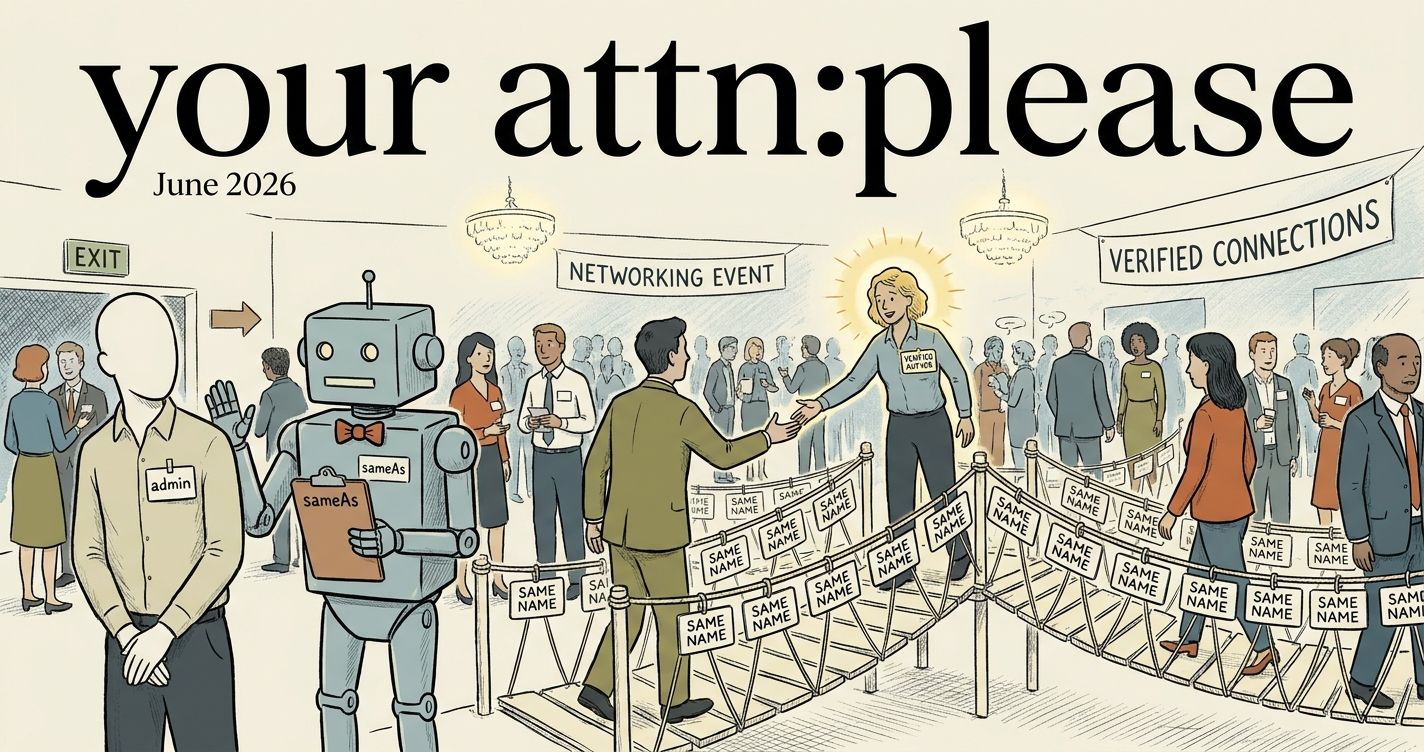
Author authority that AI trusts comes from turning your writers into recognised entities. You name a real author, give them credentials, mark them up with Person schema, and use the sameAs property to link them to their LinkedIn, Wikidata, and other profiles. That web of consistent connections is how AI confirms your author is a real, known expert worth quoting.
Anonymous content is invisible content now. AI search wants to know who wrote a thing and whether that person is real and credible. The way you prove it is technical but not hard. You make each author an "entity" the machine can recognise and verify. This guide covers named authors, credentials, Person schema, sameAs, and Wikidata, in plain terms.
What an entity is and why it matters
An entity is a thing the machine knows as a distinct, real item: a person, a company, a place. Google and AI keep a knowledge graph of entities and the facts about them. When your author is a recognised entity, the AI can confirm who they are, what they know, and that they exist. That confirmation is what makes the AI trust and quote them.
Think of it like the difference between a name on a page and a verified profile. A name alone is just text. The AI cannot tell if "Jane Smith" is a real expert or a made-up byline. But if that name is connected to a LinkedIn profile, a company page, past articles, and a Wikidata entry, all agreeing on the same facts, the machine can place her. She becomes a known quantity.
That is the whole game with author authority in 2026. You are not just signing your name. You are giving the AI enough consistent, connected proof that it can recognise your author as a real expert and trust what they wrote.
Name a real author with real credentials
The foundation is a named human author with stated credentials, not "admin" or "the team." Give every article a real byline and a proper bio: years in the field, relevant qualifications, what makes them an expert on this topic. AI and Google both read this as the first signal that a trustworthy person stands behind the content.
This sounds obvious, but most sites still get it wrong. The blog is anonymous. The bio is one vague sentence. There is nothing for a machine to verify. You have an expert on staff and you are hiding them from the exact systems deciding whether to trust your content.
Write the bio like you are introducing a real expert at an event. Who they are. What they have done. Why they know this subject. Then link it to their real profile. A named author with a credible, linked bio beats a wall of anonymous content every time, on both human trust and machine trust.
Person schema and the sameAs property
Person schema is JSON-LD code that tells the machine, in structured form, exactly who your author is. The sameAs property is the key part: it lists URLs to the same person elsewhere, like their LinkedIn, their company profile, their Wikidata entry. sameAs is how you say "this author is the same person as that verified profile," which lets the AI connect and confirm the entity.
In plain terms, schema is a label written in a language machines read perfectly. Without it, the AI has to guess who your author is from the text. With Person schema, you hand it the facts directly: name, job title, the organisation they work for, and a list of their other profiles via sameAs.
The sameAs links do the heavy lifting. Each one is a thread connecting your author to a place the AI already trusts. Link to LinkedIn and the AI cross-checks. Link to a company team page and it confirms employment. Link to past published work and it sees a track record. The more consistent threads, the stronger the entity, and the more the AI trusts the byline.
How to build a recognised author entity
You build a recognised author entity by creating consistent, connected proof of who they are across the web, then marking it up so machines can read it. Do these in order and your authors become entities AI can verify and trust.
- Give every article a real, named author. No "admin," no anonymous posts.
- Write a full bio with credentials and link it to a real LinkedIn profile.
- Add Person schema to author pages and articles, with name, job title, and organisation.
- Fill in the sameAs property with every real profile: LinkedIn, company page, past work, social accounts.
- Keep facts consistent everywhere. Same name, same title, same bio across every site the author appears on.
- If the author qualifies, create a Wikidata entry. Wikidata is a core source for the knowledge graph AI relies on.
- Build a real track record. More published, credible work strengthens the entity over time.
Why consistency makes or breaks it
The single thing that breaks author authority is inconsistency. If your author has a different name, title, or bio across LinkedIn, your site, and their other profiles, the AI cannot confirm they are one person. Mismatched facts read as several weak signals instead of one strong entity. Lock the facts and make every profile agree.
I have seen good experts undercut by sloppy details. A nickname on one profile, a full name on another. An old job title that was never updated. A bio that says one thing here and another there. To a machine assembling an entity, that is noise, and noise lowers trust.
The fix is unglamorous. Decide your author's canonical facts: exact name, current title, one consistent bio, the full list of their real profiles. Then audit every place they appear and make them match. The authors AI trusts most are not the ones with the fanciest credentials. They are the ones whose proof is consistent everywhere the machine looks.
Frequently asked questions
What is an entity in SEO?
An entity is a real, distinct thing the machine recognises, such as a person, company, or place, along with the facts about it. Google and AI store entities in a knowledge graph. When your author is a recognised entity, AI can confirm who they are and that they are a credible expert, which makes it more likely to trust and quote them.
What is the sameAs property in schema?
sameAs is a schema property that lists URLs pointing to the same person or organisation elsewhere on the web, such as a LinkedIn profile, company page, or Wikidata entry. It tells search engines and AI that your author or brand is the same entity as those verified profiles, which connects and confirms their identity in the knowledge graph.
How do I build author authority for AI search?
Name a real author, write a full bio with credentials, link it to their real LinkedIn, and add Person schema with the sameAs property listing all their profiles. Keep the facts consistent everywhere they appear. If they qualify, create a Wikidata entry. This consistent, connected proof lets AI recognise them as a credible expert worth quoting.
Do I need a Wikidata entry for my authors?
It helps but is not required for everyone. Wikidata is a core source for the knowledge graph that AI relies on, so an entry strongly anchors an author or brand as a recognised entity. You need to genuinely qualify for inclusion. Start with named authors, full bios, Person schema, and sameAs links, then add Wikidata when you are eligible.
What is Person schema and where do I put it?
Person schema is JSON-LD code that describes an author to machines: their name, job title, organisation, and other profiles via sameAs. You add it to author bio pages and to the articles they write. It hands search engines and AI the facts directly instead of making them guess who the author is from the text alone.