If you are building a new creative project or launching a marketing campaign, you already know the ultimate variable that determines your success: human behaviour.
You can design the most visually stunning assets on earth and write copy that reads like poetry, but if you don’t fundamentally understand what your target audience does and why they do it, you are essentially throwing darts in a pitch-black room.
This is where the fascinating world of behavioural science enters the chat.
At its core, behavioural science is the structured study of human decision-making, offering communication and marketing professionals a powerful framework to decode and measure real-world actions.
Adding these research methods to your toolbox is a great way to take your messaging to the next level. It moves your strategy away from subjective guesswork and anchors it in empirical reality.
However, if you are just starting to dip your toes into the behavioural science waters, the landscape can feel incredibly overwhelming.
When you look at modern research methodologies, you are instantly bombarded with jargon. Are you supposed to be investing in expensive eye-tracking hardware? Do you need facial-coding software to analyse subconscious micro-expressions? Should you be setting up complex, multivariate laboratory observations or launching massive, thousands-person quantitative studies? Or better yet, what the fuck does any of that mean???
To the majority of small-to-mid-sized brands and modern communications teams that feel you need a multi-million-dollar budget to extract game-changing behavioural insights in a freaking lab somewhere: you don’t. You just need to know how to look at the right layers of human friction.
The Myth of the Stated Preference
The first and most critical rule of behavioural science that every marketer must internalise is simple: what people say they do has almost no correlation with what they actually do.
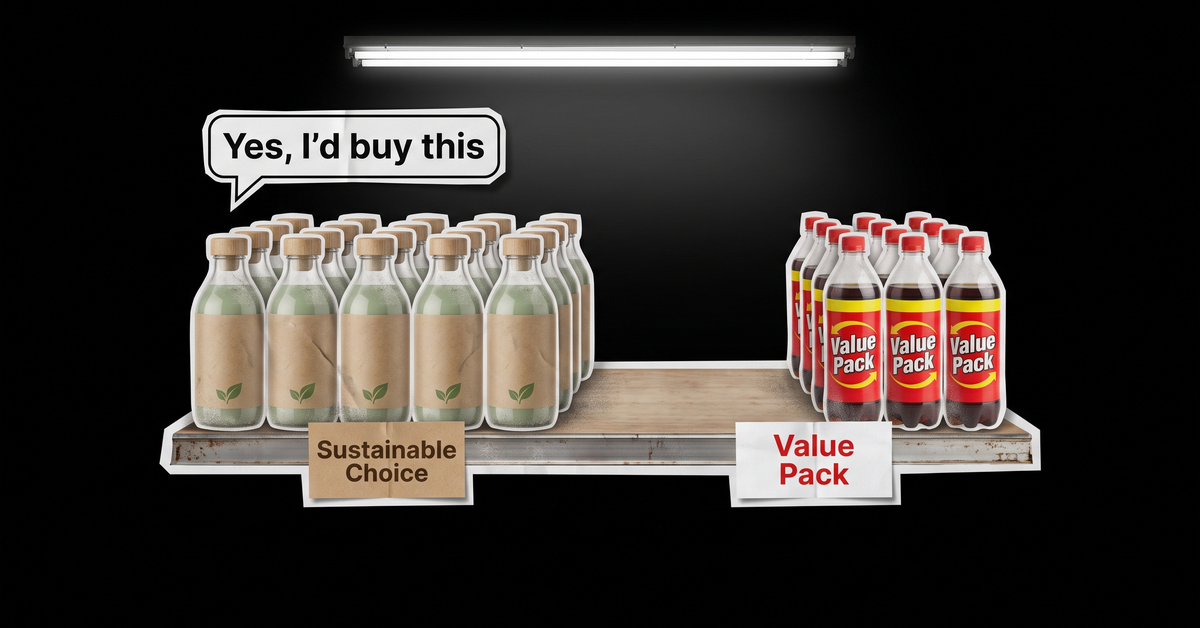
Traditional market research relies heavily on focus groups and explicit consumer surveys. You assemble a group of eight people in a room, show them a product layout, and ask, “Would you buy this sustainable, premium option over the cheap plastic alternative?”
Naturally, because humans are social creatures desperate to project an image of virtue, intelligence, and responsibility, they will say yes. They state a preference for the ethical, high-quality choice.
But when those same people are standing in a crowded retail aisle on a chaotic Tuesday afternoon, stressed out and rushing to get home, their subconscious brain takes over. They reach for the cheap, familiar option.
This disconnect isn’t because consumers are malicious, evil liars; it’s because the human brain is hardwired to conserve cognitive energy. We operate on automated heuristics and environmental cues. Therefore, to unlock true insights, your behavioural stack needs to shift away from stated preferences and toward revealed preferences, observing human behaviour in its natural habitat.
The Low-Fidelity Behavioural Stack
To build a highly effective behavioural research practice without triggering administrative overwhelm, you can categorise your toolkit into three accessible, scalable pillars:
- Behavioural Observation (Context Mapping): Instead of asking people how they navigate a digital platform or a physical retail space, simply watch them do it without intervening. Tools like Hotjar or FullStory allow digital brands to view anonymous user session recordings in real-time. By analysing where a user hesitates, where they mindlessly rage-click, or where they abandon a checkout flow, you learn infinitely more about their true psychological friction than a 20-question post-purchase survey could ever reveal.
- A/B Field Testing (Live Experimentation): The truest behavioural science laboratory is the live marketplace. Instead of over-analysing a messaging concept in a boardroom, launch two distinct, low-budget variations of a campaign simultaneously. Use platforms like Meta Ads or Google Optimise to test conflicting behavioural levers. Does your audience respond better to a message framed around loss aversion (e.g., “Don’t miss out on saving $50”) or social proof (e.g., “Join 10,000 professionals using this tool”)? Let the actual conversion data dictate the psychological profile of your buyer.
- Friction Auditing: Human beings are path-of-least-resistance animals. Often, a campaign fails not because the messaging is wrong, but because the behavioural path requires too many cognitive steps. Run a strict audit on your user journey. Count the number of clicks, the fields in a form, or the decisions a user has to make to complete an action. Ruthlessly stripping away a single layer of choice anxiety can drive a massive spike in behaviour change.
The Takeaway:
Behavioural science doesn’t require a lab coat or an enterprise-level budget; it requires a deep curiosity for actual human reality. Stop asking your audience to explain their hidden motivations to you, because they don’t fully understand them themselves. Shift your strategy toward active observation, run small-scale live experiments, and focus on removing the hidden friction points in your user journey.
When you align your brand’s messaging with how the human brain actually operates in the wild, your distribution becomes unstoppable.