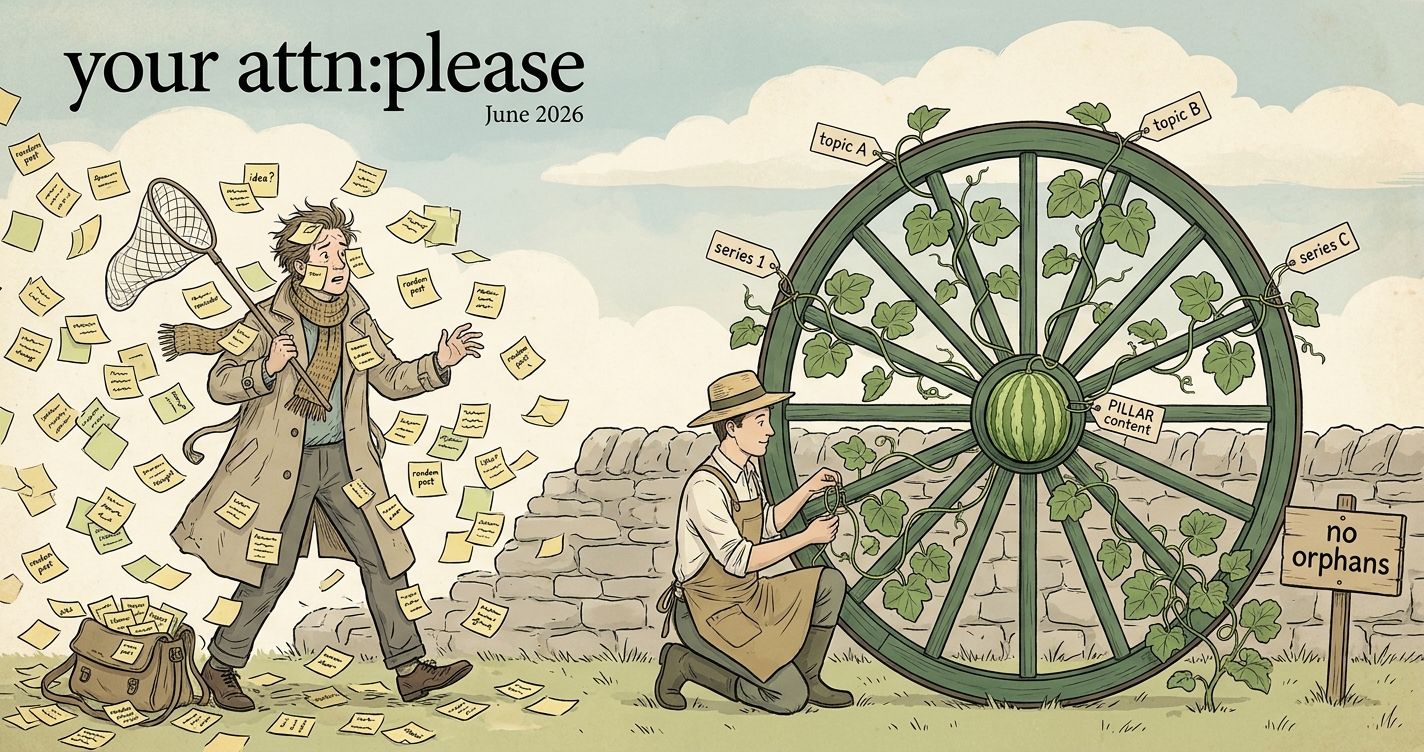
Topic clusters beat one-off blog posts because they build topical authority instead of scattered pages. The structure is one in-depth pillar page on a broad topic, surrounded by supporting posts that each cover one sub-topic, all interlinked. Done right, topic clusters lift organic traffic by 40 percent or more and raise your odds of getting quoted by AI search.
Most businesses blog the wrong way. They publish whatever comes to mind that week. A post on this, a post on that, no connection between them. Google and AI both read that as a site with no clear expertise in anything. The fix is the topic cluster. This guide covers the structure, how to interlink it, and the numbers behind why it works.
What a topic cluster is
A topic cluster is a group of connected pages built around one subject. At the centre sits a pillar page: a broad, in-depth guide to the whole topic. Around it sit cluster pages, each going deep on one narrow sub-topic. Every cluster page links up to the pillar, and the pillar links down to each cluster page.
Picture a wheel. The pillar is the hub. The cluster posts are the spokes. The links are what hold it together. A pillar might be "organic social media for small business." The spokes are "how to write a hook," "how often to post," "which platforms to pick," and so on. Each spoke is a real article. Together they prove you own the whole subject.
This is the opposite of random blogging. Instead of fifty unrelated posts, you build a tight, connected set that tells Google and AI: this site is the authority on this topic. That is what topical authority means, and it is what both search and AI reward now.
Why clusters beat one-off posts by 40 percent
Topic clusters lift organic traffic by 40 percent or more compared with scattered posts, according to topical authority research cited in our 2026 strategy brief. The gain comes from compounding. Each interlinked post passes authority to the others, so the whole cluster ranks higher than any single post could alone. The pillar rises as the spokes grow.
A one-off post stands by itself. It has to earn every bit of its ranking alone, with no support. A cluster post stands on the shoulders of every other post in the group. When one spoke earns a link or a mention, the internal links carry some of that authority to the pillar and across to the other spokes. The whole structure lifts together.
There is a second gain that matters more in 2026: AI citations. When you cover a topic thoroughly across a connected cluster, AI engines see you as a complete, authoritative source and quote you more often. A thin, isolated post rarely makes the cut. A deep cluster that answers every angle of a question is exactly what an AI wants to lift from.
How to build the structure
You build a cluster by choosing one broad topic, writing the pillar, then writing the spokes around it. Start with the topic where you have the most real expertise. Plan the whole cluster before you write, so the pieces fit together instead of overlapping. Here is the order.
- Pick the pillar topic. Broad enough to support ten-plus sub-topics, narrow enough that you genuinely own it.
- List the sub-topics. Every real question a customer asks about the pillar topic. Each one becomes a cluster post.
- Write the pillar page. A thorough overview of the whole topic. It introduces every sub-topic and links out to the spoke that covers it in depth.
- Write the cluster posts. One per sub-topic, each going deep on its single question. Each links back up to the pillar.
- Interlink across spokes where it helps the reader. Related posts link to each other, not just to the pillar.
- Keep it current. Refresh the pillar and key spokes on a 7 to 14 day cycle so the whole cluster stays fresh.
Interlinking is what makes it work
The interlinking is the engine of the whole cluster. Links are how authority flows between pages. Without them you do not have a cluster, you have a pile of posts. Every cluster post links up to the pillar, the pillar links down to every cluster post, and related spokes link to each other where it serves the reader.
Get this part right and the structure does the heavy lifting. The pillar becomes the strongest page on your site because every spoke points to it. The spokes rank for their specific questions while passing trust to the hub. A reader who lands on one post can follow the links to the rest, which keeps them on your site longer, another signal both Google and AI read.
The rule I give our team is simple. No orphan posts. If you publish something that does not link to or from the cluster it belongs to, you have wasted its authority. Every new post should slot into a cluster and wire itself into the structure on day one.
Start with one cluster, not ten
The mistake is trying to build clusters on every topic at once. Pick the single subject where you have the deepest real expertise and build one complete cluster first. A finished cluster on one topic outperforms half-built clusters on five. Depth on one subject is what earns topical authority.
For a small NZ business, this is the realistic path. You are not going to out-publish a content factory. But you can pick the one thing you genuinely know better than anyone and cover it completely. One pillar, a dozen honest spokes, all interlinked, all kept fresh. That focused cluster will out-rank and out-cite a competitor publishing twice as much across scattered topics.
Build one cluster well. Let it compound. Then build the next. That is how topical authority is actually won, post by connected post, not in a single content sprint.
Frequently asked questions
What is a topic cluster in SEO?
A topic cluster is a group of connected pages built around one subject. At the centre is a pillar page covering the broad topic, surrounded by cluster posts that each go deep on one sub-topic. Every page interlinks. The structure builds topical authority, which signals to Google and AI that your site is an expert source on that subject.
How much do topic clusters improve traffic?
Topic clusters lift organic traffic by 40 percent or more compared with scattered, one-off posts, according to the topical authority research in our 2026 strategy brief. The gain comes from compounding: interlinked posts pass authority to each other, so the whole cluster ranks higher than any single isolated post could on its own.
What is the difference between a pillar page and a cluster post?
A pillar page is a broad, in-depth guide to a whole topic that links out to every sub-topic. A cluster post goes deep on one narrow sub-topic and links back up to the pillar. The pillar is the hub, the cluster posts are the spokes, and the internal links between them are what build authority.
How many posts should be in a topic cluster?
There is no fixed number, but aim for one pillar page plus around eight to fifteen cluster posts that each answer a real customer question about the topic. Quality and completeness matter more than count. A cluster that thoroughly covers every angle of a subject earns more authority than one padded with thin posts.
Do topic clusters help with AI search?
Yes. When you cover a topic thoroughly across a connected, interlinked cluster, AI engines like ChatGPT and Perplexity see you as a complete, authoritative source and quote you more often. A thin, isolated post rarely gets cited. A deep cluster that answers every angle of a question is exactly what AI search wants to lift from.