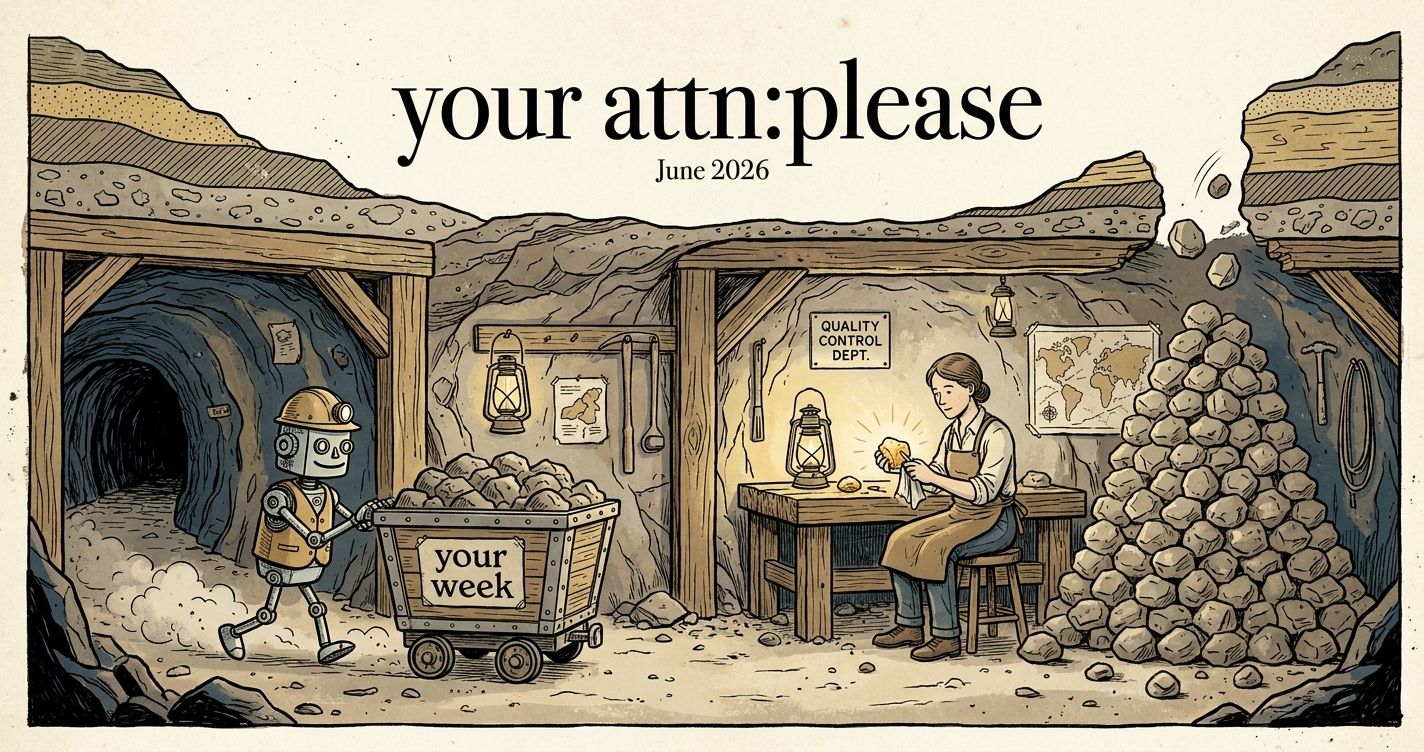
The mistake most people make is using AI to write their posts. The people doing AI content well use it as a speed layer. AI's job is not to create ideas. It is to surface the stories already in your life, draft them fast, and get them 80 percent of the way there. You add the 20 percent that makes it sound like a person, not a machine.
I spent a year building an AI system called KEVAN into how attn:seeker creates content. Not just for clients. For my own LinkedIn and Instagram too. This guide covers the workflow, why most people use AI wrong for content, and how to build a setup that saves you hours a week without turning your content into slop.
Why most people use AI wrong for content
Most people open their AI tool of choice and type: write me a LinkedIn post about social media marketing. The output is technically correct and completely forgettable. Generic insight. Generic tone. No specificity, no voice, no story. Nothing that would make anyone stop scrolling.
The tool is not the problem. The input is. AI cannot invent good ideas from nothing. It can only work with what you give it. If you give it a vague prompt with no real information, you get vague content. If you give it a real story from your week, your voice in examples, and a clear brief, you get something worth posting.
Think of AI as a content miner, not a content creator
The mental model shift is this: AI does not create your content. It mines it.
You live your life. Calls, client work, problems solved, moments that made you think. You have had dozens of conversations this week that contained something worth sharing with your audience. Most of those moments disappear because you are moving too fast to notice them. AI can surface them if you give it access to your world.
The workflow that works
Here is how the AI content workflow runs at attn:seeker. This is what I use for my own LinkedIn and Instagram output.
- Give AI access to the raw material. The KEVAN system has access to my calendar, email, and meeting transcripts. Every 24 hours, it scans what happened.
- Let it find the content opportunity. KEVAN reads the last day and looks for moments that connect to my core topics: social media strategy, short-form video, LinkedIn, AI and marketing. It surfaces the ones most likely to be useful for my audience.
- Let it draft. KEVAN writes a post in my voice, using the broetry format, my sentence structure, my vocabulary. It has learned how I write from dozens of examples. The draft gets to about 80 percent of where it needs to be.
- I add my 20 percent. I edit the draft. I put in the line that is specifically me. I shift the tone where it sounds too polished. I add the detail only I would know, the moment inside the moment.
- It schedules and goes live. Once I approve the draft, KEVAN sends it to the scheduler. It posts at the right time without me copy-pasting anything.
The result: I never miss a week of content. Every post is built on something real from my actual life. The AI found the story and wrote the frame. I wrote the soul.
The way I describe it: that thing you said at that talk the other day, or in that prospect meeting, was really interesting. Let us turn that into a piece of content. The AI writes it as best it can and gets it about 80 percent of the way there. I add my 20 percent, which makes it human and makes it me.
How to build this yourself without a custom system
You do not need a fully integrated system to start. Here are three practical workflows you can run today.
Workflow 1: the voice note to post
After a meeting, a presentation, or a conversation that sparked an idea, record a 90-second voice note. Rambling is fine. You are capturing the thought while it is fresh.
Transcribe it using Otter, Fathom, or the built-in transcription on your phone. Drop the transcript into your AI tool with two things: three to five examples of your best past posts so it knows your voice, and a brief asking it to turn the transcript into a post in your format. Edit the output. Read it out loud. Add the line that only you would write.
Workflow 2: the calendar scan
At the end of each week, paste your calendar into your AI tool. Ask it: which of these meetings or events contains a story or lesson my audience would find useful? Pick two and draft a LinkedIn post for each. The AI will find patterns you missed. You edit and post.
Workflow 3: the repurposing run
Take one long piece of content: a webinar recording, a podcast episode, a long client conversation. Get the transcript. Ask the AI to pull out five post ideas and draft them in your voice with your examples. One hour of content becomes a month of posts. This is the fastest return on AI content work.
Training your AI on your voice
The quality of AI content is directly tied to how well you have trained the tool on how you write. Here is how to do it.
- Collect 15 to 20 of your best-performing posts. The ones that sounded most like you and got real responses.
- Give them to the AI as reference material. Label them: this is how I write, this is my voice, match it.
- Every time you get a draft, note what it got wrong. Add those corrections to your prompt over time. The brief gets better and so does the output.
- Use voice notes as input more than written prompts. Your spoken voice is usually closer to how you write on social media than your formal written voice.
The goal is not perfection. It is getting the AI to the 80 percent so your 20 percent effort goes further.
Frequently asked questions
Can AI really write social media posts in my voice?
Yes, with the right setup. It takes some work upfront: collecting examples, writing a clear brief, correcting early outputs. But once the AI has your examples and a clear sense of your format, the drafts get close. You still edit. That edit is what makes it yours.
What AI tool works best for social media content?
The model matters less than the workflow. Claude, ChatGPT, and Gemini all work well for this. The more important variables are how much real input you give it (real stories, real examples, real voice) and how clearly you brief it. A good workflow with an average model beats a great model with a vague prompt.
Will my audience know my content is AI-assisted?
If you add your 20 percent properly, no. The goal is not to hide AI. It is to use AI to surface stories from your real life and draft them faster. The ideas and the experience are yours. The AI helps you find them and write a first frame. The edit is where you make it human.
How much time does AI content creation actually save?
Most people who build a proper AI content workflow cut their creation time by 60 to 70 percent. The time saved is in research, first drafts, and scheduling. The edit still takes time. But that is the valuable work. The rest is just friction.
Do I need access to my calendar and emails like KEVAN does?
No. The full system is the advanced version. The voice note workflow gives you 80 percent of the benefit with no setup. Start there. Record your thoughts right after something interesting happens. That is the whole strategy at its simplest.