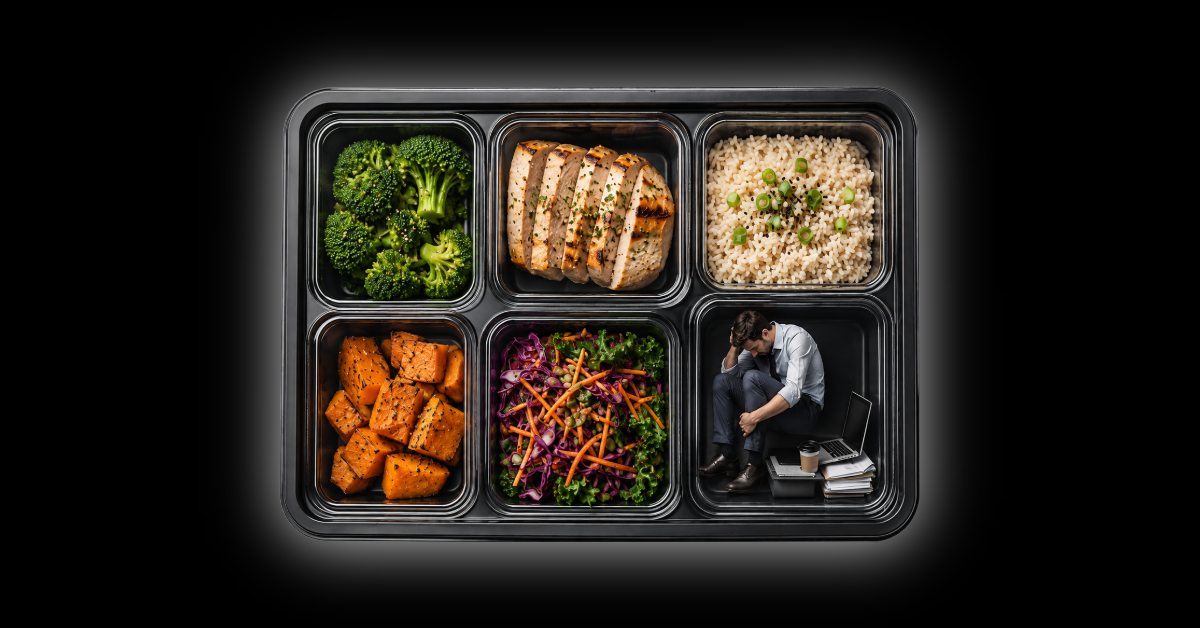
Today I was thinking about the pre-made meal box industry.
And the mental rabbit hole I found myself in made me shudder.
It’s always been an option I’ve considered. I’m currently studying, working, making content, doing 10k + steps a day and trying to make it to the gym without passing away. Sometimes the last thing I want to do is cook. But I also don’t want to DoorDash myself into oblivion. I have protein goals to hit.
I always get ads on my timeline and think “oh, they don’t look so bad” with their minimalist branding, vibrant colour palettes, and smiling, busy professionals pulling a neat plastic tray from a cardboard box after a long day at the office.
There also seem to be a lot of influencers pushing them right now.
And I can see why. The narrative is an easy sell; it’s peak modern problem-solving. And these subscription services are an “act of liberation” designed to save us precious time, eliminate the stress of grocery shopping, and streamline our nutritional intake for peak metabolic efficiency.
But let’s look behind the glossy cardboard wrapping and at the underlying sociology of this massive boom… the illusion of convenience is actually a deeply dystopian reality.
The system has successfully commodified how f*cking tired we are.
The modern economic landscape demands an unsustainable volume of work, just to maintain a baseline of middle-class survival.
We are expected to give our undivided cognitive attention, our nights, and our weekends to corporate dashboards, endless slack threads, and freelance pipelines. By the time we finally close our laptops or log out of our project management systems at the end of the day, our basic cognitive and physical reserves have been absolutely depleted.
We are left in a state of structural paralysis. And we’re too profoundly tired to even perform the basic human act of cooking an actual meal from scratch.
This is where the predatory genius of the pre-made meal market takes root. Because it takes the epidemic of burnout and turns it into a multi-billion-dollar monetisation opportunity.
They exhaust us to the exact point of domestic paralysis, and then they step in to sell us the solution to the very crisis they created.
Instead of restructuring the labour market or returning our time, they sell us a subscription box. One filled with hyper-processed, vacuum-sealed gloop that we are forced to heat up in a microwave for three minutes. We are trading the ancient, grounding ritual of preparing nourishment for a transactional convenience utility designed to get us fed as fast as possible. So we can get right back to working for the machine.
The true cultural tragedy of this shift is the slow erasure of the kitchen as a sanctuary of human agency.
For thousands of years, the act of cooking was one of the most foundational, tactile, and communal anchors of the human experience.
It was a space where we were forced to slow down, engage with the physical world, work with our hands, and share a collective ritual with the people we cared about. It’s a natural pattern-interrupter that forces us out of our heads and back into our bodies.
By converting this sacred process into a standardised, plastic-wrapped subscription unit, we are allowing the optimisation doctrine of the corporate boardroom to colonise our very nutrition. To treat our bodies like machines that just need a quick injection of fuel, rather than complex biological entities that require connection, texture, and care.
We cannot standardise and optimise ourselves out of basic human ritual. For the love of god, reject the corporate gloop.
-Sophie Randell, Writer