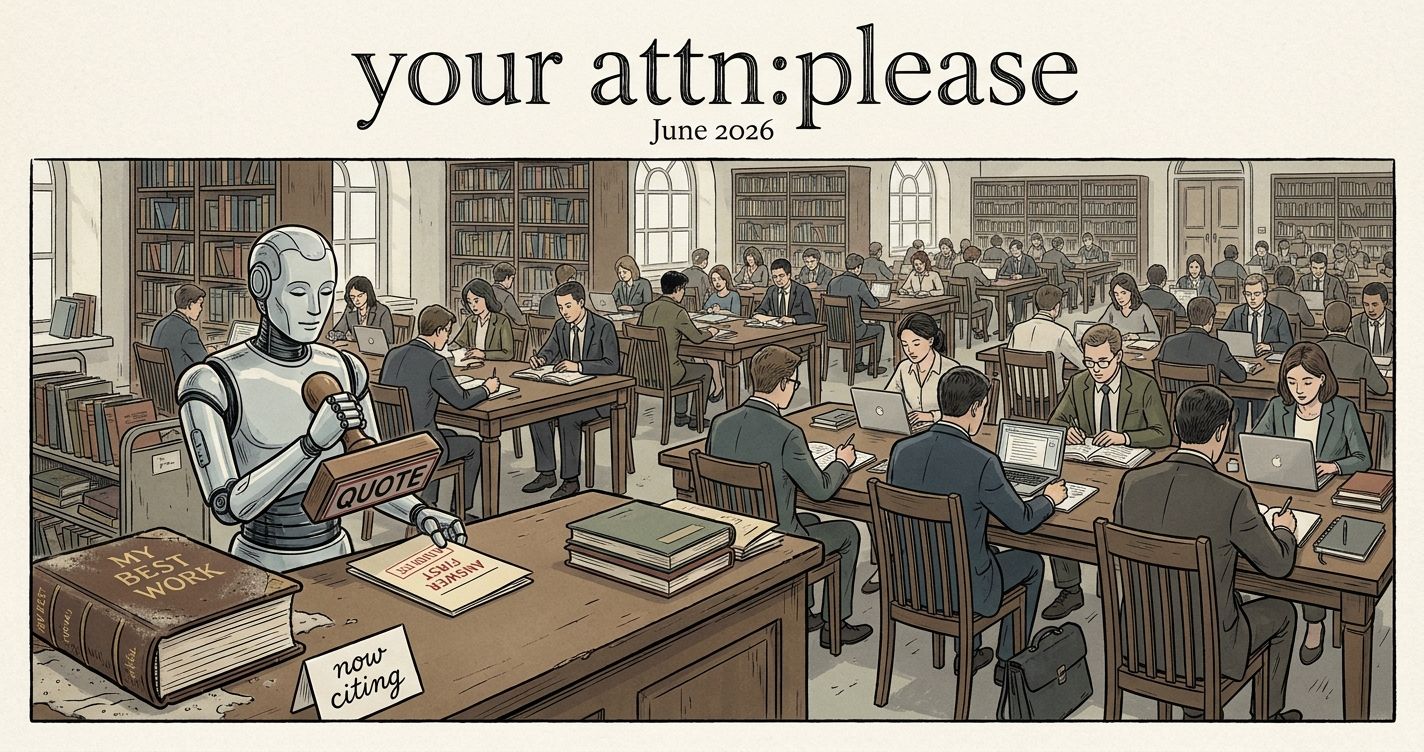
To get cited by AI search, give the machine something clean to lift. Answer the question in the first two sentences. Put a clear definition near the top. Load the page with specific data and quotes. Use short paragraphs, descriptive headings, and tables. Add FAQ schema. Earn mentions on sites the AI already trusts.
I run a social media and education business in New Zealand. Search changed shape under us. People used to scroll a list of blue links. Now they read one AI answer and never click. Our SEO partner, The Optimisers, leads our AI-search work, and the playbook below is the one they operate from. This is the practical checklist for getting your content quoted inside ChatGPT, Perplexity, and Google AI Overviews.
Why getting cited is the new ranking
Getting cited means the AI quotes your page inside its answer. Ranking means you sit in a list of links a user might click. Those are now two different games. Search has two front doors. One ranks links. The other quotes a source. You want to be the source the AI names.
This matters because of zero-click. About 65 percent of searches now end with no click, according to widely reported 2026 search data. The user reads the answer and moves on. If your page is not the one the AI pulled from, you got nothing. No visit. No mention. No trust.
The good news is the same content can win both. You do not pick SEO or GEO. Strong, well-sourced, well-structured content ranks in the list and gets quoted in the answer. You write for humans and for machine extraction at the same time.
Answer the question in the first two sentences
Lead with the answer. AI lifts the direct answer block from the top of your page. If you open with a story, a welcome, or a long wind-up, the machine has nothing clean to quote and it skips you. The first two sentences should answer the exact question the page is about.
Most blog posts do the opposite. They warm up. "In today's fast-moving world, businesses are always looking for..." Nobody quotes that. Not a human, not a machine.
Here is the fix. Write the answer first, as if someone asked you the question out loud and you had ten seconds. Then explain underneath. Do this for the whole page and for every section. Every heading should open with its own short answer before the detail.
Put a definition near the top
Define your main term early and plainly. AI cites clean definition statements often, because a definition is the cleanest possible answer to a "what is" question. State what the thing is in one tight sentence, then expand.
A definition box near the top of the page does heavy lifting. "GEO is the practice of getting your content quoted inside AI answers." That is liftable. The AI can drop it straight into a response and credit you.
Write the definition the way a person would say it, not the way a textbook would. Plain words win. The machine matches your phrasing to the question someone typed. The closer your words are to real speech, the better your odds.
Load the page with real data
Specific data raises your citation odds more than anything else. Numbers, percentages, dated stats, and named-source quotes give the AI something concrete and credible to pull. Vague claims get ignored. A specific stat with a source gets quoted.
Compare these two lines.
- "Topic clusters can really boost your traffic."
- "Topic clusters lift organic traffic by 40 percent or more, according to multiple 2026 SEO studies."
The second one gets cited. It has a number, a frame, and a source said in plain words. The first one is noise.
Use first-hand data where you have it. Our own numbers, like adding over 180,000 followers to our Instagram in a year, are the kind of specific, owned proof that machines and humans both trust. Cite your sources by name in plain language inside the sentence.
Structure it so a machine can read it
Structure for extraction. Short paragraphs, question-style headings, bullet lists, and comparison tables all parse cleanly. A wall of text does not. The machine needs to find the answer block fast and lift it without guessing.
Here is the structure that works.
- Question-format headings. Use "What is FAQ schema?" not "Introduction." The heading should match how people ask.
- Short paragraphs. Two to four sentences. Long blocks bury the answer.
- Bullet and numbered lists. AI parses steps and items cleanly.
- Comparison tables. When you compare two things, a table gets pulled almost whole.
- A "last updated" date. AI favours fresh sources, so show it and refresh priority pages every week or two.
Add schema so the AI knows what it's reading
Schema is code that labels your content for machines. It does not change what a human sees. It tells the AI "this is an article, this is the author, this is an FAQ." That labelling makes your content easier to lift and trust. Add it to every page.
The ones to use are Article, FAQPage, HowTo, Organization, and Person. They are written in a format called JSON-LD and sit in the page's code. Your developer or your CMS can add them.
One property matters most: sameAs. It links your brand and your authors to their real profiles, like LinkedIn and Wikidata. This is how the AI's knowledge graph learns who you are and connects the dots across the web.
Earn mentions on sites the AI already trusts
Off-page is half the game. AI pulls from sites it already trusts, so brand mentions matter more than ever, even ones without a link. Get named in industry roundups, "best of" listicles, reviews, and forums. Reddit especially. The AI reads all of it.
Entity consistency is the quiet move that wins. Use the same brand name, the same facts, and the same profiles everywhere. That consistency is how the machine learns who you are and stays confident enough to name you.
For Kiwi businesses, this is reachable. Get listed in local roundups. Get reviewed. Show up on LinkedIn and YouTube with the same name and the same story. You do not need a huge budget. You need to be consistent and present where the AI looks.
Frequently asked questions
How long until AI starts citing my content?
It varies. On-page fixes like answer-first openers, definitions, and schema can be picked up within weeks once your pages are re-crawled. Off-page signals like brand mentions and entity consistency take longer to compound, often a few months. Start with the on-page work because it is fully in your control and fastest to ship.
Do I have to choose between SEO and GEO?
No. The same content wins both. A page with strong topical authority, real data, clean structure, and E-E-A-T ranks in the link list and gets quoted in the AI answer. They overlap heavily. Write for the human reader and for machine extraction at once, and you cover both front doors.
Which AI engine should I optimise for first?
Optimise for the principles, not one engine. All of them favour clear, factual, well-sourced, recently-updated content with a direct answer up top. Google AI Overviews leans on pages that already rank, so classic SEO still feeds it. Perplexity shows its sources, so good structure wins there directly.
Does schema really make a difference?
Yes. Schema labels your content so machines understand it without guessing. FAQPage schema in particular is linked to higher citation rates in AI answers. It is one of the lowest-effort, highest-return moves you can make, because it is a one-time code addition that keeps paying off on every page you add it to.
How do I measure if AI is citing me when there are no clicks?
Track citation rate and share of model. Pick 20 to 50 priority questions, then check monthly how often your brand appears across ChatGPT, Perplexity, Gemini, Copilot, and Google AI Overviews. Citation rate is pages cited over pages tracked. Share of model is your citations over total citations for those queries.