
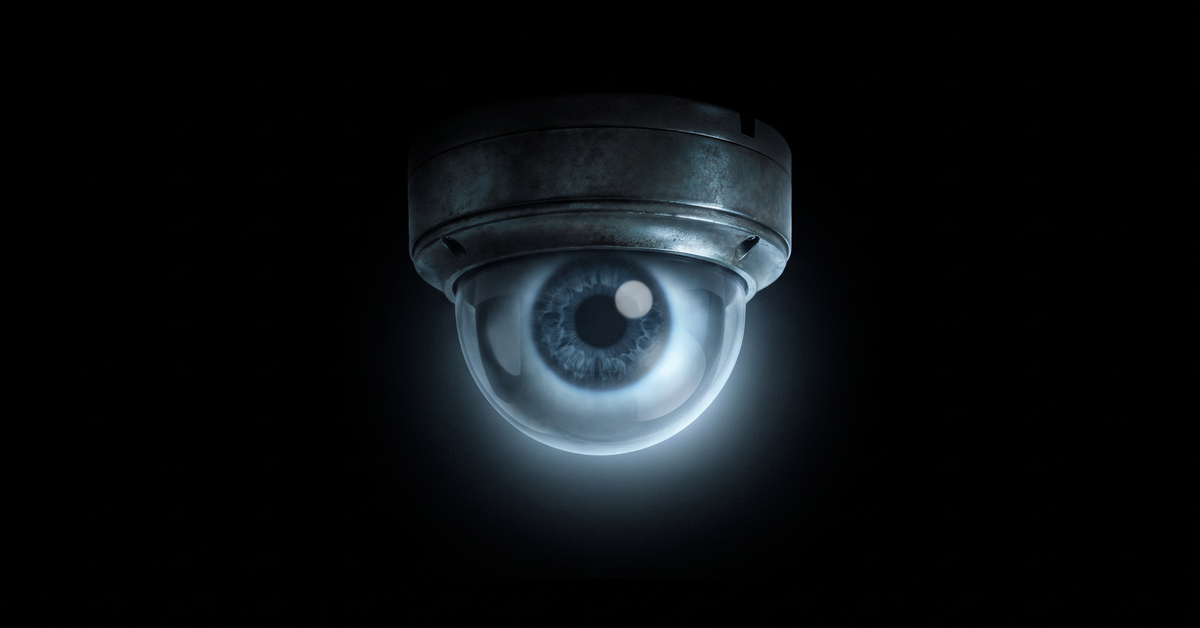
I’m currently teaching my Year 13 students about the Found Footage horror genre, because it’s a well-known anchor to a specific historical trauma. Films like Cloverfield, The Blair Witch Project, and Paranormal Activity were the cultural artifacts of a society undergoing severe surveillance anxiety in the shadow of 9/11, the Patriot Act, and the sudden, creeping reality of the NSA.
Found footage worked so damn well because it weaponised the shaky, unedited perspective of the citizen-journalist or the hidden home security camera. It asked a terrifying question: Who is watching us through the lens, and what happens when they look back?
But today, that question feels futile.
We are no longer anxious about the possibility of being watched because we’ve actively surrendered to it.
We are well and truly living in the fully realised panopticon state. So, if not “surveillance anxiety”, what do we call what we feel right now? And what media do we have to reflect it?
We have transitioned into a condition known as Omnipresent Entrapment.
No longer afraid of the camera in the corner of the room, yet afraid of the fact that we cannot exist without becoming the camera. Our horror is no longer about being watched (or attacked) by a faceless government entity; it’s the genuine terror of being perceived, documented, and processed by ourselves, our peers, and the machine at every single second of our lives.
The Shift from Found Footage to Screenlife
If the handheld camcorder was the weapon of choice for post-9/11 horror, the modern architecture of fear is defined by the Screenlife genre.
Think of films like Searching, Missing, Unfriended, or the psychological techno-thriller series Black Mirror. In these films, the entire narrative takes place on a computer desktop, a smartphone screen, or a FaceTime call. The camera is no longer a tool a character picks up to document a monster; the screen is the monster.
In the Screenlife era, the horror comes from the total collapse of the private self. Every text thread, Google search, every cached location tag, open tab becomes a digital paper trail that can and will be used against you. The anxiety isn't that a ghost is lurking in your house; it's that your digital footprint has created a synthetic version of you that you can no longer control.
This is the evolution of the panopticon. In the original philosophical model of the panopticon, prisoners behaved because they thought a guard might be watching them from a central tower. In 2026, we have internalised the guard tower. We willingly document our own lives, broadcast our locations, and feed our biometrics into the system for the sake of lifestyle curation and social validation. We are both the prisoners and the guards.
The Horror of Algorithmic Inevitability
The modern cultural shift has also birthed a new subgenre of dread: Algorithmic Horror.
Look at experimental digital media or internet horror projects like The Backrooms or analog horror series on YouTube. These narratives don't rely on jump-scares or traditional monsters. Instead, they evoke terror through endless, sterile, procedurally generated spaces that feel like they were constructed by a broken, fucked up algorithm. They reflect a systemic dread about the loss of human agency.
We feel trapped inside an optimisation loop. When your phone predicts what you want to buy before you say it out loud, or when an app dictates your economic value and social access, the human condition begins to feel entirely automated.
The modern horror protagonist isn't running from a killer in the woods.
We’re trying to escape a data model that has already predicted our demise.