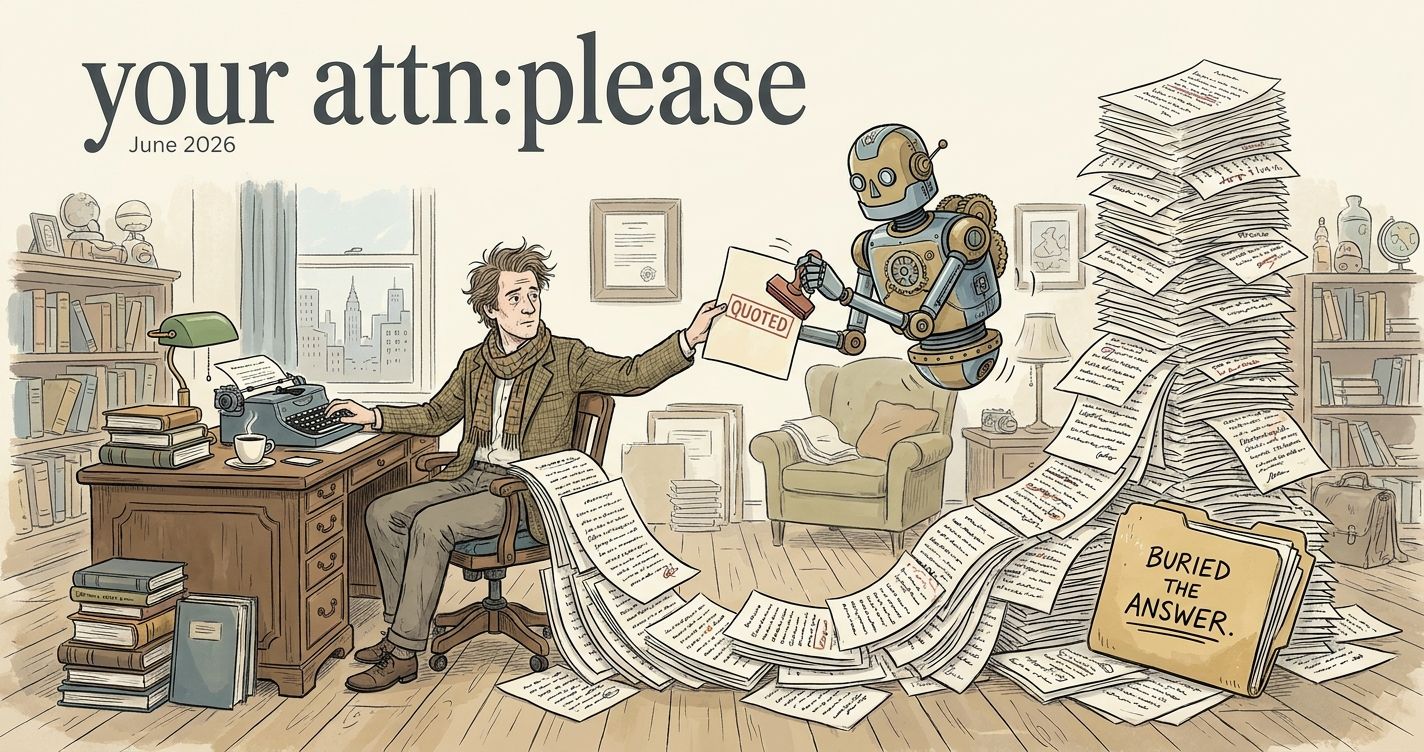
AI citation rate is the share of your tracked pages that AI engines actually quote. You work it out by dividing the pages cited by the pages you track. If you track 20 pages and AI answers cite 5 of them, your citation rate is 25 percent. It tells you whether your content is good enough for AI to repeat.
I run a social and education brand in New Zealand, and citation rate is the metric I check first now. Not rank. Not clicks. Citation rate, because it answers the most basic question in AI search: is my content the kind of thing the machine wants to quote. If the answer is no, nothing else matters. This guide covers what citation rate is, what a healthy number looks like, and exactly how to measure and lift it.
What AI citation rate is
AI citation rate is a simple fraction: pages of yours that get cited, divided by the pages you are tracking. A citation is any time an AI answer names your page, links to it, or clearly uses its content to answer a question. The metric tells you how often your content earns a quote, in plain percentage terms.
It is content-level, not brand-level. That is the key difference from share of model. Share of model asks how often your brand wins against rivals. Citation rate asks how often your own pages are good enough to be quoted at all. One is a competition score. The other is a quality score for your library.
Think of it as a hit rate. If you have written 30 guides and AI engines only ever quote 3 of them, your citation rate is low and your library has a structure problem. Fix the structure and the same content starts getting quoted far more often.
Why citation rate matters more than rank
Citation rate matters more than rank because being quoted is the new being clicked. In a no-click world, a page that gets cited is doing its job even when nobody visits it. The AI is carrying your message to the buyer for you. Rank position cannot see that. Citation rate can.
There is a second reason. Citation rate is something you control. You cannot force the AI to rank you, but you can write a page so clearly and factually that the AI struggles not to quote it. Citation rate measures exactly the things you can change: clear answers, real data, clean structure. It turns a fuzzy goal into a number you can move.
For a small business this is freeing. You are not waiting on the algorithm gods. You are improving a hit rate you have direct control over, page by page.
What a healthy citation rate looks like
A healthy citation rate climbs over time and varies by how competitive your topics are. Early on, anything above 10 to 15 percent on your tracked pages is a real start. Strong, well-structured content libraries push past 30 to 40 percent on their priority questions. The honest answer: aim up, and judge the trend more than the absolute number.
Why no single magic figure exists:
- Competitive topics are harder. "Best CRM software" has thousands of strong pages fighting for the citation. A niche local question has far fewer.
- The engines change their answers constantly. The same page can get cited this week and skipped next week.
- New pages take time. The AI needs to find, trust and start quoting fresh content. Give a page weeks, not days.
So set a baseline this month, then chase improvement. A library that goes from 12 percent to 28 percent cited over a quarter is winning, even if 28 sounds modest.
How to measure your citation rate
You measure citation rate by listing the pages you care about, testing the questions they answer, and counting how many get cited. The method is the same by hand or with a tool. Keep it consistent so the trend holds up.
The manual process:
- List your tracked pages. Start with your 15 to 30 most important guides and product pages.
- For each page, write the real question it is built to answer. Use the words a customer would speak.
- Run each question through ChatGPT, Perplexity, Gemini and Copilot.
- Mark a page as cited if any engine names it, links it, or clearly uses its content.
- Divide cited pages by tracked pages. That is your citation rate. Save it and repeat monthly.
Perplexity is your friend here because it shows its sources openly. You can see your page get cited in real time, which makes it the fastest place to test whether a change worked.
How to lift a low citation rate
You lift a low citation rate by making your pages easier to quote. AI engines lift clean, self-contained answers. If your page makes the AI dig for the point, it moves on to a page that does the work for it. Most low citation rates come from the same handful of fixable problems.
The fixes that move the number most:
- Answer the question in the first two sentences. The AI lifts the direct answer block. Bury it and you lose the quote.
- Add real data. Specific numbers, percentages, dated stats and named sources raise citation odds more than anything else.
- Put a clean definition near the top for your main term. AI quotes tidy definition statements constantly.
- Structure for extraction. Short paragraphs, question-style headings, bullet lists and comparison tables.
- Add an FAQ section that mirrors the exact questions people ask.
- Show who wrote it. A named author with real credentials and first-hand experience builds the trust the AI rewards.
Apply these to your lowest performers first. Tools like Profound, Otterly and Peec can track which pages are getting cited so you know where to aim. Most small NZ brands find a few quick structural fixes lift their citation rate fast, because so many competitors still bury their answers.
Frequently asked questions
What counts as a citation for AI citation rate?
A citation is any time an AI answer names your page, links to it, or clearly uses its content to answer a question. A direct link in Perplexity counts. So does ChatGPT paraphrasing your specific data or definition without a link. If the AI is repeating your content to a user, that is a citation worth counting.
What is a good AI citation rate?
There is no single magic number, because it depends on how competitive your topics are. Early on, 10 to 15 percent of tracked pages getting cited is a solid start. Strong content libraries push past 30 to 40 percent on priority questions. Judge the trend over months rather than chasing one perfect figure.
How is citation rate different from share of model?
Citation rate is a quality score for your own pages: how many of them get quoted. Share of model is a competition score: how often your brand is cited versus rivals for a question. Citation rate asks "is my content quotable." Share of model asks "am I winning." You want both climbing.
How fast can I improve my citation rate?
Structural fixes can show up within weeks once the AI re-reads your pages. Move the answer to the top, add real data, tidy the definition and structure, and your most-buried pages often start getting cited again. New pages take longer because the AI needs time to find and trust them. Give fresh content several weeks.
Do I need a paid tool to track citation rate?
No. You can list your key pages, run their questions through the main AI engines, and log which get cited in a spreadsheet. It costs nothing but time. Paid tools like Profound, Otterly or Peec automate the tracking and tell you which pages are cited, which is worth it once you scale beyond a handful of pages.