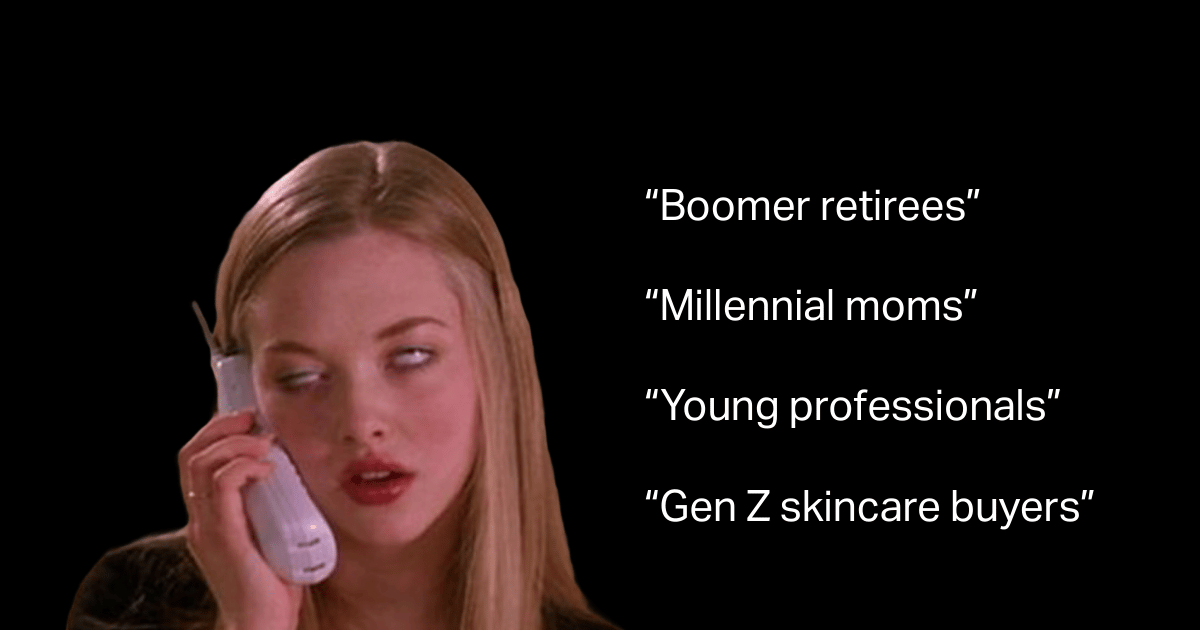
For decades, marketers have sliced and diced audiences into generational boxes like Gen Z, Millennials, Gen X, and Boomers.
As if a birth year could reliably predict someone's values, shopping behaviour, or go-to sunscreen brand.
But here's the problem: age doesn't define behaviour anymore. Identity does. And identity isn't shaped by a decade of birth. It's shaped by what people care about, what they're drawn to, what they want more of in their lives.
In short? People don't group by age. They group by desire.
The real shift is from demographics to shared tensions.
The "target demo" still shows up on briefs like it's 2004. "Women aged 25-34, urban-based, high income..." Cool. And what exactly does that tell us about how they think? What they feel tension around? What they aspire to?
Two people with a 40-year age gap might both want to feel:
In control of their time
Less anxious about money
More creatively expressed
More connected to their body
More "main character energy" in their day-to-day
Those are desires. And they transcend age, income, and even geography.
That's why desire is the new demographic.
Smart brands are moving away from generic customer segments and toward psychographic clustering, using motivations, values, and aesthetics to understand how people move through the world.
Here are a few examples of how to rethink your audience:
"Young professionals"
"Gen Z skincare buyers"
People who want to feel adventurous again
People obsessed with rituals of self-optimisation
People looking for control and autonomy in chaotic environments
People who crave freedom from structure and time-sucking routines
The shift isn't subtle. It's a complete rewire. You're not asking how old are they? You're asking: What itch are they trying to scratch? What problem are they solving for emotionally, not just functionally?
Case in point: Who's
It's not just 22-year-old influencers. It's also 42-year-old execs, 60-year-old ex-dancers, and 35-year-old software engineers. What they share isn't age. It's a desire to feel:
Strong without burnout
Calm without checking out
Feminine without performance
That's not a demographic. That's a shared cultural tension. And it's much more valuable than a birth year.
Think aesthetics, not age.
The rise of internet aesthetics (think: Clean Girl, Coastal Cowgirl, Techno Minimalist Dad) is proof that people group themselves around self-expression and aspiration, not census data. A 19-year-old and a 49-year-old can both buy into the same aesthetic because it reflects who they want to be seen as. It says something about their inner world.
The girl boss-to-soft-life pipeline
The functional beverage obsession
The "I need my space" design movement
The return of analogue (books, film cameras, flip phones)
These are all desire signals. Watch them, and you'll understand people better than any age chart could ever offer.
So, how do you use desire-led strategy?
1. Start with tension. What's your audience feeling right now? What's frustrating, missing, or unresolved in their life?
2. Map cultural desires. Track what's rising in the culture. Not just on the explore page, but in behaviour. Think: rituals, micro-obsessions, lifestyle edits.
3. Create for identity, not category. Don't just sell a product. Sell who they want to become when they use it. Make it easy for them to see themselves in the story.
4. Test for resonance, not just reach. Forget mass appeal. Does your brand make the right people feel seen, heard, and aligned?
The most powerful brands today aren't targeting demos.
They're tapping into shared inner worlds.
The next time someone in your agency asks, "What's our target audience?" Don't say: "25-34, urban, female-presenting."
Say: "People who are trying to feel at home in their body again."
Or: "People who think self-discipline is the ultimate flex."
Because once you understand what someone wants, you can meet them there, no matter their age.
-Sophie Randell, Writer