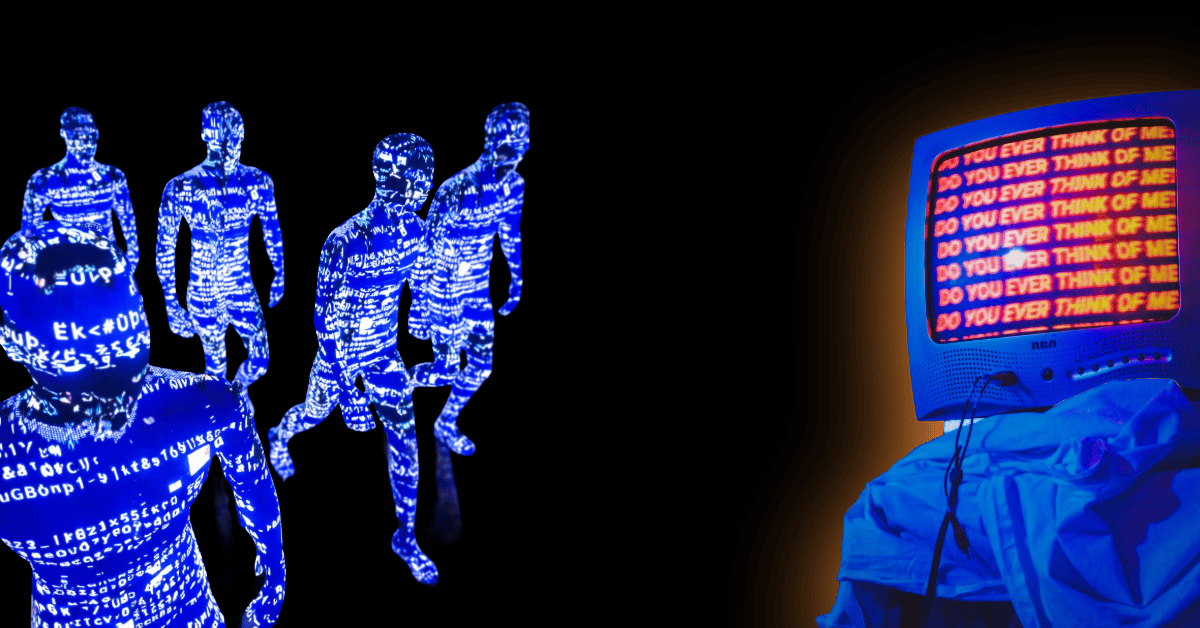
Here's a fun little spiral I recently experienced that now, you can too:
I just watched a video of someone reacting to a video essay about someone else's analysis of a viral moment that was, itself, staged content. The creator pointed out they were pointing out the conventions of pointing things out.
I laughed. I pondered.
And then I had a small existential crisis about what exactly I'd just consumed.
This is when I realised that video was not an anomaly. I've been watching content like this for months now. I was just unable to recognise the trend that was emerging: we've accidentally created the Real Metaverse… not through VR headsets, but through an infinite loop of content referencing itself, until nobody remembers what the original point was.
And somehow, this is the content we can't get enough of.
Let's map the madness, shall we?
We've got:
Content about making content.
Your setup tour is now more valuable than the thing you're setting up to film. "Day in the life of a content creator" has become its own genre. Because apparently watching someone plan what to film is more interesting than what they actually film.
Content about other people's content.
Commentary channels dissecting drama. Reaction videos to reaction videos. Video essays analysing why other video essays work. We've created an entire economy around explaining content to people who just watched the content being explained.
Content about content conventions.
Creators ironically calling out "and this is where I'd normally beg you to like and subscribe" while literally doing it. The knowing wink to the audience that we're all in on the joke, except the joke is that we're still playing along.
Content about the content ecosystem itself.
Videos titled "I cracked the algorithm" getting pushed by the algorithm they claim to have cracked. Meta commentary about engagement farming that is, itself, engagement farming. It's turtles all the way down, baby.
Now, this isn't random. We hit saturation point somewhere around 2023.
And once there's too much content, organising and contextualising that content becomes valuable in its own right.
According to recent trends, one could assume that viewers now spend more time watching analysis of viral moments than the viral moments themselves. Goodbye consumption, hello, consuming of the consumption.
And this is where it gets properly existential: showing the machinery has become the ultimate form of authenticity. In a world drowning in polished, AI-assisted, algorithmically optimised slop, pulling back the curtain actually feels real. Never mind that pulling back the curtain is now its own performance with its own curtain. We're sophisticated enough to know we're being sold to, so creators sell us the selling itself.
The platforms are catching on too.
Meta and YouTube recently cracked down on "unoriginal content.” But they're careful to distinguish it from commentary, reaction videos, and analysis. Because that meta layer? Well, that's the good stuff right there. That's what keeps people scrolling.
A beauty guru explaining their lighting setup gets more engagement than the makeup tutorial. A creator breaking down why their video went viral spawns more copycats than the original video ever did.
So where does this go? Are we sustainable, or are we about to implode under the weight of our own self-reference?
Here's my cynical take: we're training entire generations to be critics rather than consumers.
To analyse rather than enjoy. To deconstruct rather than create. When behind-the-scenes has behind-the-scenes, and commentary has commentary on the commentary, you start to wonder, what's actually left?
The optimist in me (look, I know she's small, but she's there) thinks maybe this is just evolution.
Maybe we're collectively developing a new literacy where understanding how content works is as valuable as the content itself. Maybe meta-awareness isn't creative exhaustion; it's the next creative frontier.
The pessimist in me (yes, the wolf I feed) thinks we're just running out of ideas and dressing up our recycling in increasingly elaborate intellectual frameworks. "I'm not making another reaction video, I'm deconstructing the reaction video format itself." Sure, Jake.
And this is what really gets me... at what point does self-awareness become the product?
When you're three layers deep in irony, pointing out you're pointing out you're pointing out the thing, are you even really saying anything anymore? Or are we all just trapped in an infinite content feedback loop, desperately trying to add our own spin to the spin of the spin?
So maybe this next phase for creators is making content about making things. It’s no longer entertainment; they're entertaining us about being entertained. And we're eating it up. Because somehow, watching someone film themselves preparing to film themselves feels more honest than whatever they were going to film in the first place, I guess?
But hey, at least the engagement metrics are through the roof.
Now if you'll excuse me, I need to go film a video about writing this article about the phenomenon of making content about content. The algorithm demands it.