I’ve always been enthralled by the Instagram archive page.
I’m an aesthetic girly. I love to feel inspired by cool pictures of pop culture and curated vibes.
These pages have always served as the internet’s communal mood board, whether it’s the lo-fi nostalgia of @bapeaesthetics, the high-concept design of @hidden.ny, or the subculture deep-dives of @onlystarleft, these accounts have become one of the primary ways we consume fashion, art, and history.
They're kind of the digital pulse of what’s cool. But a recent announcement from Meta suggests this era might be coming to an end, and it’s making a lot of us, myself included, deeply fkn sad.
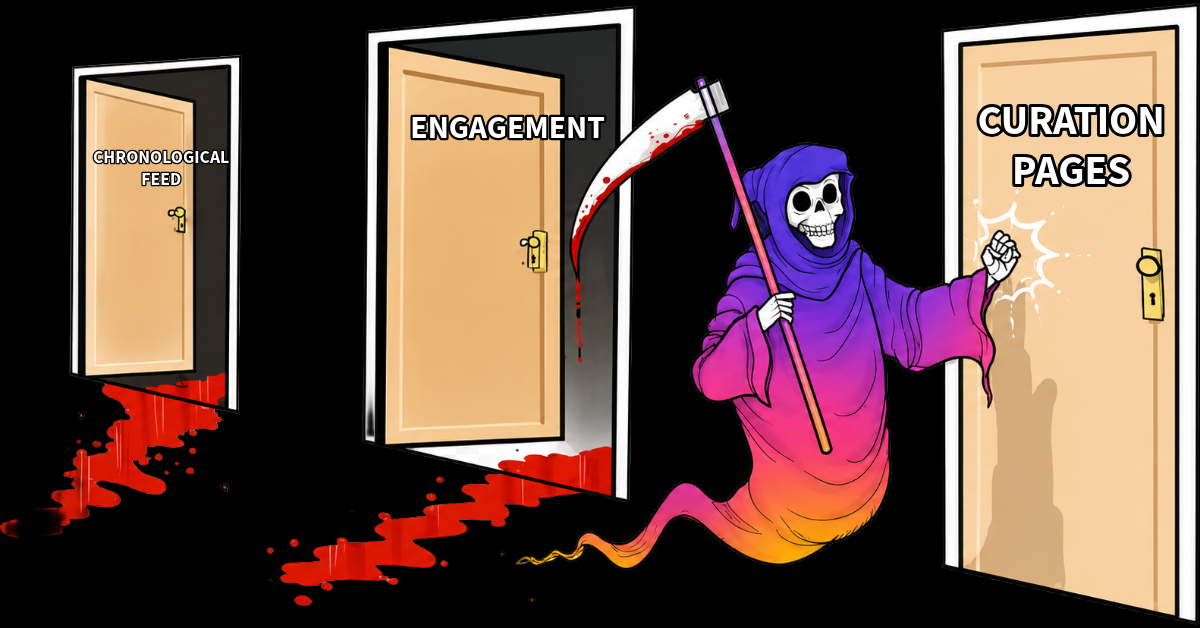
Meta’s new policy targets repost pages that lack “original value”.
This effectively strips them of their ability to be recommended in the algorithm. On the surface, the logic is sound: protect original creators from having their work stolen by accounts that simply scrape and repost for engagement. At first I was all "yay, original creators won't have to worry", that’s kind of the moment we’ve all been waiting for.
But then I realised, for the pages that exist within these digital subcultures, it’s actually "oh no, my faves are going to be pushed out by the algorithm”. For them, this move feels less like a security update and more like a cultural lobotomy.
The debate hinges on a single, slippery phrase: original value.
To an algorithm, a repost is just a duplicate file taking up space. But to a follower, a post from an archive page is a piece of a larger puzzle. I’ll say this one time and one time only: CURATION IS AN ART FORM IN ITSELF.
It’s literally the difference between walking into a warehouse full of random paintings and walking into a gallery put together by someone with a distinct point of view. Archive pages do more than repost random sh*t; they’re contextualising, they're the real chronically online historians who spend hours digging through defunct Japanese magazines or obscure 90s runway shows to bring us a specific aesthetic blueprint.
They do all the hefty legwork so we can have the inspiration.
We follow pages like @hiiihorse or @artifaxing for their taste. In an era of AI-generated sludge and fast content, human taste is becoming our most valuable currency. Traditional blogs and media companies operate with massive teams and commercial interests, but archive pages are often passion projects run by individuals. They represent the indie spirit of the original internet: raw, niche, and deeply personal.
By flattening these pages into repost bots, Meta is effectively saying that the organisation of ideas has no value - only the creation of the raw material does.
But listen, we are f*cking drowning in content.
So right now, the person who tells us what matters can be just as important as the person who made it. This policy risks creating an algorithm of boring, where the discovery of niche subcultures is replaced by a sanitised stream of original content that lacks any connective tissue. Let’s be honest, a lot of these creators are just replicating the same trends and styles, so how original really is it?
The irony of Meta’s crackdown is that these pages often drive more discovery for original creators than the algorithm does. An artist might get buried in the noise of the Explore page, only to be discovered and credited by a curation account that understands that artist’s place in a specific movement.
These pages act as the middleman between the obscure and the mainstream. By de-prioritising these nodes of connection, Instagram risks becoming a sterile environment where only the loudest voices are heard, while the quiet threads that connect them are cut.
There’s also the question of what happens to our collective memory.
Many of these archive pages serve as the only accessible records of pre-digital or early digital culture. When an archive page is wiped or hidden, we lose a curated history of a specific moment in time… be it 2016 nostalgia or 90s streetwear. We are essentially burning down digital libraries because we don't like the way the books were shelved. That’s messed up.
While the community will likely (and hopefully) prevail, moving to Substack, physical zines, or whatever platform emerges next, the loss to Instagram’s cultural ecosystem is massive. More so than people realise, I think.
We’re trading human-led discovery for safe recommendations.
If we lose the tastemakers, we lose the soul of the feed.
-Sophie Randell, Writer