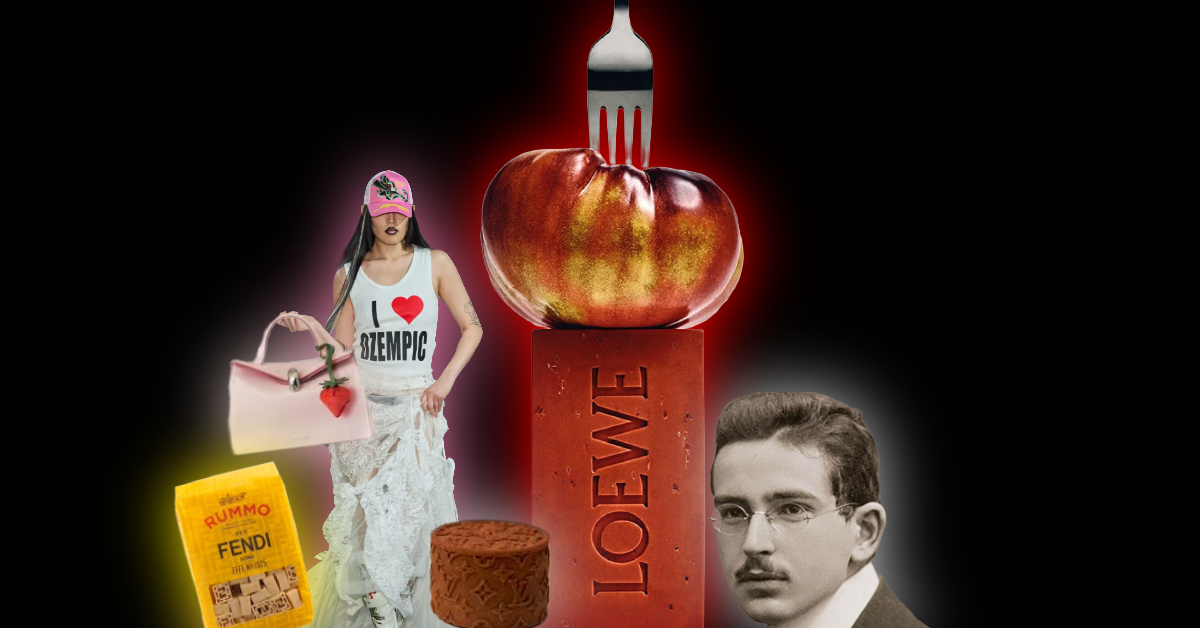
Have you guys noticed something about major fashion campaigns in the last few years?
In the hallowed halls of Harrods and the sleek boutiques of SoHo, food has undergone a radical rebranding. It is no longer a biological necessity, but a seasonal accessory in these campaigns.
Think about Loewe’s hyper-realistic Tomato Clutch (a $4,000 "meme-to-reality" masterpiece), or Jacquemus’s buttered-toast invitations and "milk carton" bags.
It would seem the fashion industry is currently obsessed with the pantry.
But this gastro-fashion movement is emerging at a strange crossroads. Just as GLP-1 medications are causing a literal collapse in American caloric demand, luxury brands are filling the void with gold-leafed lattes and leather produce.
I can’t help but ask, what the actual fudge is going on here?
We are witnessing the birth of some kind of inedible smorgasbord, in a culture where food is most valuable when it’s never actually eaten.
Food has become a primary "prop" for luxury brands to signal authenticity and slow living.
Jacquemus serving breakfast at the opening of its New York Boutique in SoHo from a branded truck is about narrative, not nutrition. Which is a shame, because I think buttery croissants are peak nutrition, but anyway.
In our hyper-digital world, physical objects like a perfect heirloom tomato or a crusty baguette represent "the old world". They're organic, tactile, and rooted in heritage. By turning these staples into leather charms (cough** Le Valérie charms in the shape of carrots and strawberries), brands are selling a curated version of pastoral life.
A deeper, more unsettling critique is also emerging: the fascism of aesthetics.
This theory, often linked to Walter Benjamin, suggests that fascism turns everyday life into a highly choreographed performance to distract from material realities.
When luxury brands co-opt peasant staples like bread, milk and tomatoes, and then turn them into high-priced accessories, they are aestheticising the tools of labour and survival. It creates a "performative poverty" or a curated reality where the mass struggle for food is ignored in favour of its visual beauty.
By making food fashion, we participate in a quiet dogma where how a meal looks is more important than its communal or nutritional reality. It reduces a universal human right to a signifier of elite status.
Then there’s the GLP-1 paradox of looking like you don't eat.
The most "now" element of this trend is its timing alongside the GLP-1 boom. As medications like Ozempic and Wegovy rewire the affluent brain to desire fewer calories, the fashion industry is rewiring their eyes to desire the image of food more.
The statistics are startling. Households with GLP-1 users are reportedly spending significantly less on groceries. Some data suggests a nearly 10% drop in food spending among high-income users. In this Ozempic era, the ultimate luxury is a small appetite.
Eating a high-calorie raspberry croissant at the fuchsia Choo Café in Harrods is positioned as a flex. Because it suggests you have such biological control (or a high-end prescription) that you can be surrounded by luxury carbs without consuming too many of them.
It’s the same reason Louis Vuitton opened Le Café V in Osaka and Tokyo.
In a market saturated with resale handbags, "hospitality luxury" provides an ephemeral, un-copyable experience. Brands are stepping into the "spending vacuum" left by declining food budgets to offer experiences that don't have calories, but do have high social currency.
Whether it’s the Jimmy Choo Café’s branded lattes or Fendi’s monogrammed pasta, the goal is the "check-in," not the meal.
As food is stripped of its biological function, it is repurposed as a class marker. In this strange, new reality, the most fashionable thing you can do with a baguette today isn't to share it, but to wear it.
-Sophie Randell, Writer