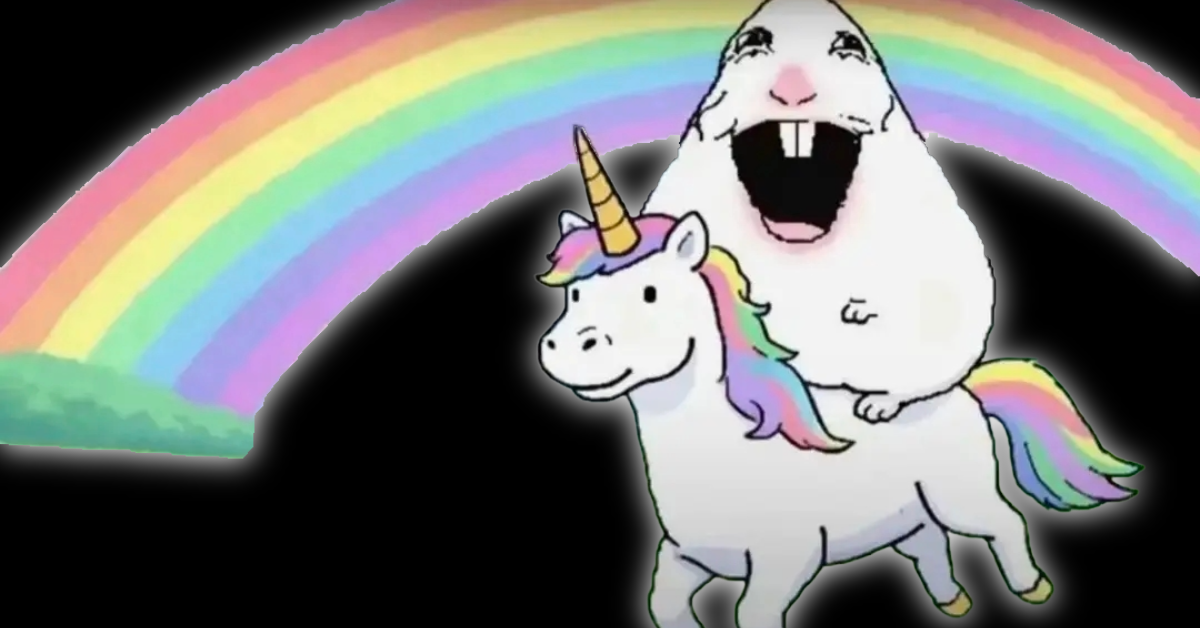
Get in loser, we’re going frolicking in a daisy field, or something.
We’re also putting pink streaks in our hair again, and wearing polka dots and long socks and humming in public. Most importantly, WE’RE NOT LETTING THE DARKNESS TAKE US.
I’m not just talking about some cute trend or perceived vibe shift. This is a data-backed rebellion.
Hinge recently reported a 75% global increase in users mentioning “whimsy” in their prompts over the last six months.
Google trend searches have sharply increased. Even fashion and art have begun to explore new mediums and expressions of whimsy. And it's gone past the giant red MSCHF boots a few years back and into a surge in oversized products and elements.
In a digital landscape that’s been absolutely dominated by “quiet luxury” and hyper-curated sad beige aesthetics, we’re finally witnessing a hard pivot toward the radically unserious. It’s a pivot I’m welcoming with open arms and a warm hug, but it’s also a potential secret weapon for the marketing industry in the year to come.
Culture analysts are calling the shift a desire to be unserious in a serious world.
We all know the horrors are upon us. It’s a dark time full of uncertainty, and people have realised they can’t keep optimising every second of their lives.
Especially not in these circumstances.
Let’s look at whimsy, then, as an antidote to the burnout from all of this. Whimsy keeps us safe. And I know that sounds absolutely insane, but it kind of acts as a protective layer for the nervous system. By leaning into unproductive, by intentional joy, like oversized buttons and hairclips or surrealist art, we’re reclaiming our time from the so-called “efficiency” of the algorithm.
The surge in oversized objects and products like giant hairclips and buttons and massive bows is also about scale. They make us feel small, surrounded and safe. We can mentally shrink the overwhelming problems that the modern world presents us.
These Alice in Wonderland proportions are the perfect example of whimsy in effect.
While whimsy sort of begun as a stylistic choice, it’s moving toward a measurable demand signal.
For brands, it means moving away from perfect and toward playful.
If we want to get granular about it, research shows that consumers engage in more hedonic buying when exposed to "whimsically cute" products. It literally lowers the cognitive barrier to purchase because it makes us feel like it’s just a little treat rather than a utility. So yeah, whimsy can actually hack your brain into buying cute sh*t.
Another tactic to consider: the whole blind box phenomenon. Tell me that’s not our inner whimsy kicking and screaming and saying I WANT A SONNY ANGEL AND I WANT IT NOW and then not letting you leave the store without spending an absurd amount of money on a little naked doll with a duck hat on.
It’s the whimsical cuteness effect. And it’s strong af.
Due to the death of the curated feed, experts (me, I’m the expert) believe that those who embrace unconventional thinking and PR stunts that feel like stumbles into Wonderland or some kind of dreamscape will outperform other brands this year.
There’s one thing I want to be clear about: Whimsy is not the same as infantilisation.
But there is a fine line between reclaiming joy and denying maturity.
Historically, culture has used "childlikeness" to strip women of their power. We’ve seen a wave of nauseating "girl dinner," "girl math," and "clean girl" aesthetics. And this "girlification" can inadvertently reinforce the idea that adult women aren't mature, professional, or worthy of the title "woman". It keeps us submissive and dependent.
Whimsy, by contrast, is an active choice made by us adults with agency. It’s a rebellion, about imagination and heightened sensitivity, not a lack of intelligence.
While infantilisation is often about a "collective regression" into passive consumption, whimsy is healing and productive for the creative brain, allowing adults to re-engage with suppressed parts of their selfhood.
The lesson here is we want to empower, not belittle. There’s a difference.
So, I’m going to set you a challenge (for your brand or your brain).
Instead of passively watching the trend, test its engagement power this week with something like this:
- The surrealist post: If you’re a creator, post one thing that is "out of scale." A tiny chair? A giant pencil? Your head blown out of proportion? Watch how the "unserious" interrupts the scroll.
- The surrealist statement: Wear one thing that is "too big" or "too bright" specifically to a high-stakes meeting or event. It’s an act of power, proving you can be both highly competent and deeply playful at the same time.
- The 0% utility rule: Look I’m not here to encourage your reckless spending. But buy one small thing this week, a sticker, a weird charm, a "fancy spoon" that has zero functional purpose other than making you smile.
- The scenic route: Take 10 minutes to do something "inefficient." The algorithm hates it; your brain will say “mwah, mwah, mwah – I love it.”
Stop playing it safe in the beige. The world is sad enough as it is.
We’re not touching grass. We’re frolicking, bitches. Get amongst it.
-Sophie Randell, Writer