It doesn’t take a genius to see that America is celebrating its 250th anniversary amidst peak political polarisation.
And yet, if you scroll through TikTok, you’d think the country has never been more united (hear me out).
I don’t mean with the constant hammering of difference in opinion, red v blue, man v woman, trans or no trans, abortions or no abortions (y’all are exhausting, I’m sorry).
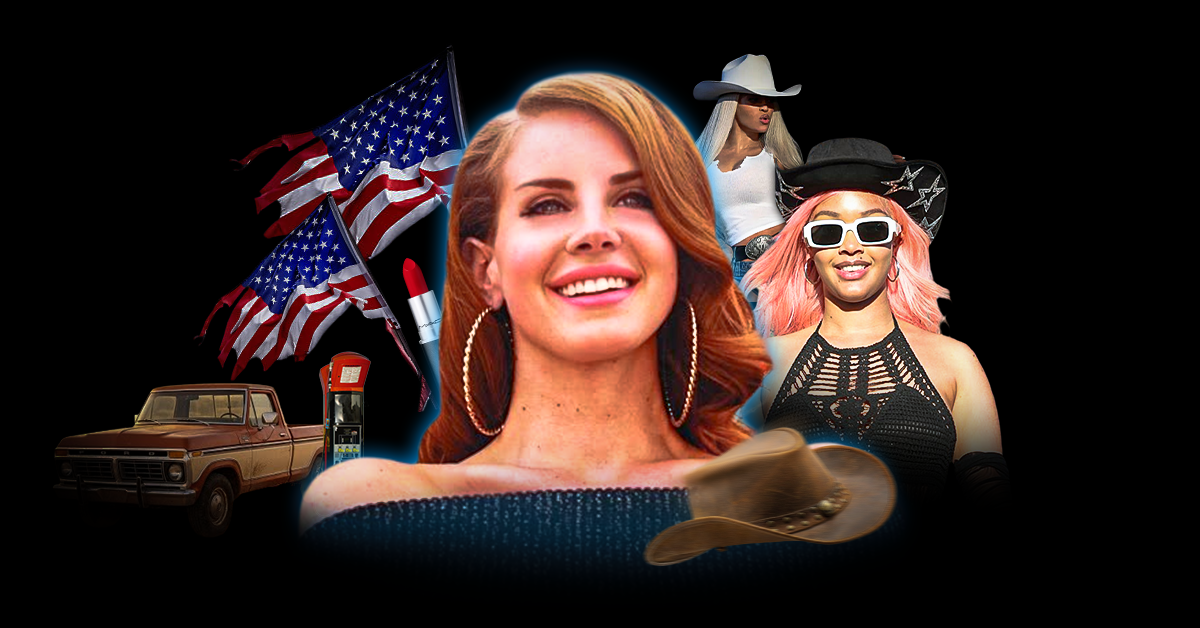
I’m talking about everybody all of a sudden flaunting chunky American flag sweaters. Styling gingham skirts and pigtails and Levis. And sound-tracking their GRWM videos with Lana Del Rey or tracks from Beyoncé’s Cowboy Carter era.
But, look closer. This is not your parents’ patriotism.
This is a highly calculated, character-driven digital costume. At a time when taking pride in the nation feels more than complicated for young consumers, Americana aesthetics are absolutely everywhere.
And as a marketer, I think it’s imperative we to understand why. Because imo, this phenomenon is a masterclass in identity decoupling and empty-vessel branding. And it showcases the new rules of the creator economy.
For Gen Z, it seems Americana has been completely detached from its political reality.
It no longer represents a state of the union and now simply represents a vibe. The cohort treats historic cultural codes like a cinematic wardrobe. This is a shift away from traditional patriotism, which is historically tied to ideology, nation, and policy. Instead, it's moving toward a post-pathetic Americana rooted entirely in irony, cosplay, and character archetypes.
It’s definitely not about buying into the American political system; but instead, into a sort of "IYKYK" lifestyle club.
By stripping the red-white-and-blue of its nationalist weight, they’ve transformed it into a blank canvas for personal branding. To put it plainly, Americana is now just another "core" to cycle through, sitting on the digital wardrobe shelf, right next to "brat" and "coquette." It is an aesthetic playground.
One where consumers can wear the flag completely ironically, or purely because the silhouette looks good on camera. They are playing a character in a digital movie, and Americana is the ultimate costume design.
This subcultural shift is not happening in a vacuum.
Smart brands are actively engineering the tools for this national cosplay, acting as the ultimate costume designers. Take a look at mass-market retail strategy. Heritage labels are thriving by leaning into universal messaging. They're deliberately avoiding explicit political ties and polarising narratives.
Instead, they focus entirely on selling raw, tactile heritage, cinematic nostalgia, and adaptable silhouettes like heavy-weight denim, weathered leather, and workwear jackets.
By presenting these items without rigid, traditional definitions, brands create an empty vessel.
A Carhartt jacket can be worn by a rural construction worker or a hyper-urban TikTok stylist in New York. Neither consumer feels alienated. Because the brand sells the physical asset while letting the consumer inject their own irony or sincerity. Brands are selling the raw materials for a digital fit check, devoid of the “American Dream” messaging they once came with.
We can see this empty-vessel strategy firing on all cylinders with the massive success of recent heritage brand campaigns.
Consider the BEYONCÉ x LEVI’S® Reimagine global partnership. Levi's has always been synonymous with Americana. But here, the brand completely reinvented their historic 1980s ads to craft a new cultural narrative centred around The Denim Cowboy.
By framing their legacy denim as a modern, empowering uniform, the campaign pulled in over 4.3 billion impressions. And it generated over $65 million in estimated earned media value, driving double-digit growth in their women's business.
Similarly, Lucky Brand did the same with the younger demographic.
The brand recently partnered with pop star and MOTHER Addison Rae for y2k inspired capsule collection. Lucky released pieces like the ultra-low-rise Addison Short specifically targeted at festival season (of course, to be worn with cowboy boots). In doing so, they turned traditional Americana denim into a viral, accessible costume for the digital age.
The speed at which this costume spreads comes down to trend loop acceleration.
We know this.
When a subculture sparks a look, whether it's Beyoncé's denim lifestyle campaign or a viral festival outfit, it triggers an immediate algorithmic ripple across social platforms.
A user sees an icon styled in Americana, replicates the look using a vintage flag sweater, and formats it as an aesthetic carousel on Instagram. This loop moves seamlessly from subcultural spark to algorithmic ripple, ending in instant commerce via social checkout. For digital marketers, this is the ultimate playbook.
If your product or brand narrative feels like a movie set, the modern consumer will buy the product just to play the character in their own feed. They want to participate in the cultural moment. And buying the clothes is the easiest form of ticket entry.
The Americana boom proves that in the modern creator economy, context beats reach.
And aesthetic flexibility will alwayyyys beat rigid corporate messaging.
Consumers do not want brands to tell them who to be or what to vote for. They want brands to give them the wardrobe to express who they want to seem to be online.
If you can turn your product into a piece of a larger cultural costume, the algorithm will do the rest of the selling for you.
I could put money on that.
-Sophie Randell, Writer