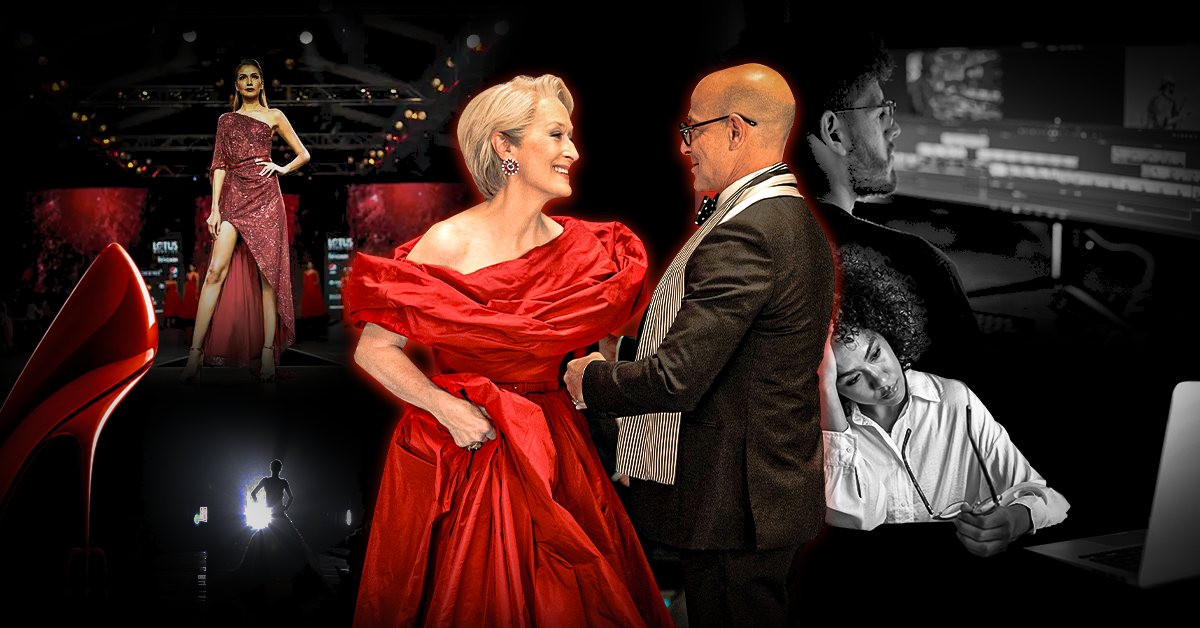
Hollywood’s shiny new box-office hit The Devil Wears Prada 2 treats fashion reporting like an aspirational, ultra-glamorous dream.
If you’re familiar with the film (as you should be) you’ll know editorial jobs are fiercely guarded treasures. And high-fashion spreads still stop the world in its tracks. Yet outside the cinema doors, the reality for modern journalists is a relentless, exhausting uphill battle.
Fiction sells us a world of champagne-soaked creative brilliance. Meanwhile, the industry is literally fighting for its life. Ongoing industry monitoring reveals that over 3,400 journalism job cuts were recorded across the UK and US last year alone.
Print advertising budgets are being heavily cannibalised by generative artificial intelligence and individual creator-economy influencers. Entry into traditional media has become incredibly difficult. And it's left industry professionals struggling to pay their rent. All while Miranda Priestly declares on screen that "everybody wants this."
As digital publishers, we must ask: why are audiences still buying into a glamourised media landscape that no longer exists?
The answer lies in highly targeted nostalgia marketing.
Studios leverage our collective memory of the early-2000s fourth estate to sell ticket packages. They feed a public fatigued by fragmented, short-form digital channels. Consumers do not want the reality of metric-driven curation. They want the fantasy of the untouchable gatekeeper.
The Fictional Myth & The Digital Reality
Exclusive runway curation ───> SEO and keyword stuffing
Uncompromising creative voice ───> Algorithmic feed optimisation
Massive editorial budgets ───> Corporate cost-minimisation
This glaring division reveals an even deeper issue in modern corporate marketing.
The iconic Miranda Priestly of 2006 was legendary for her sharp, uncompromising, and deeply offensive management style. In the modern landscape, that character has been significantly defanged to align with modern corporate compliance, corporate governance structures, and strict HR feedback frameworks.
This sanitised evolution directly reflects how modern marketing agencies operate. The era of the bold, eccentric creative director who relies entirely on gut instinct is being actively phased out. In their place sit predictive data analytics dashboards, focus groups, and algorithmic trend forecasting tools.
We've flattened internal creative hierarchies and aggressively removed all distinct brand risks. Now, corporate entertainment and advertising are both creating far safer… and significantly more forgettable products.
The plot of the sequel focuses heavily on traditional print media facing complete collapse.
Despite this narrative, the film relies on a massive corporate safety net of physical product tie-ins and commercial brand collaborations just to sustain its production costs. Traditional publishing is forced to scramble for survival. Yet its fictional counterpart can comfortably use high-concept prestige branding to bypass authentic media channels entirely.
Audiences are not actually looking for a fashion reporter's real career path. They are simply buying into a carefully engineered, hyper-commercialised luxury simulation.
For modern marketing teams, the true lesson of The Devil Wears Prada 2 is clear. If your real-world product is struggling to survive, you can always choose to package its ghost as pure luxury entertainment.
-Sophie Randell, Writer