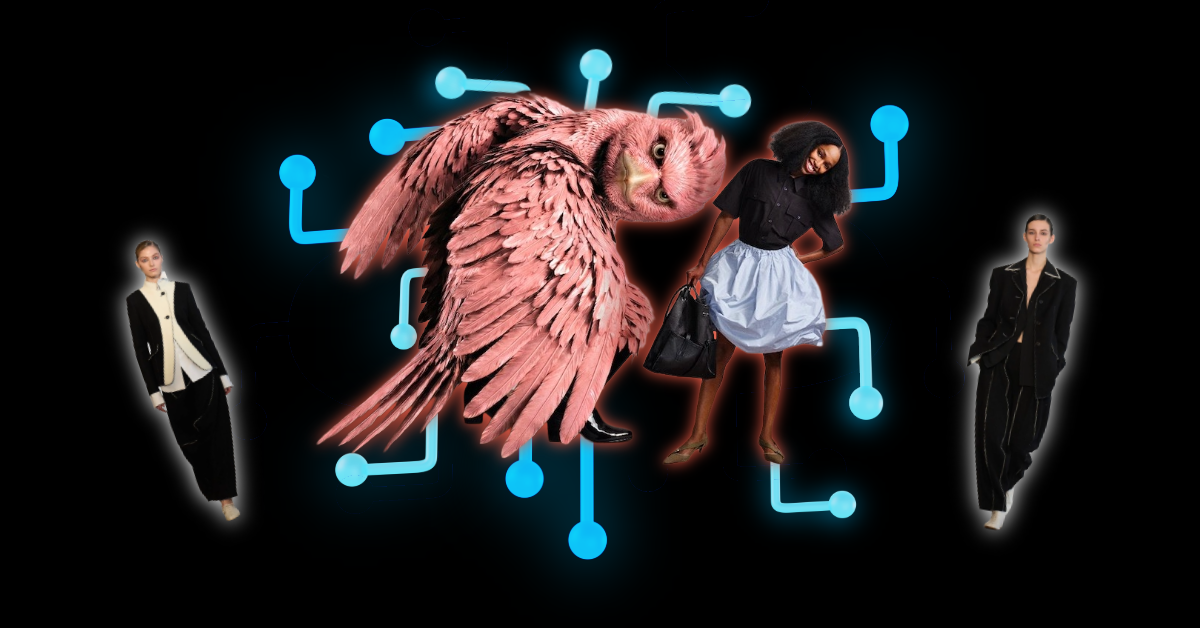
Prada's Spring 2026 campaign is intentionally unstable, disturbing, and very surreal.
Everybody’s pissed about the AI aesthetic. Yet the brand calls it "ceaseless possibilities, multiplicities of identity and being." Meanwhile, in the same space, somewhat of a protest has begun.
WGSN titled this shift towards process-driven aesthetics “#WorkinProgress.”
With the likes of unpolished looks, process-driven aesthetics, hand drawn/ collage like or even brush stroked graphics and prints. There are worn out textures, or faded, washed looks reemerging on the runway.
Prada presented designs featuring intentional abrasions. Emilia Wickstead embraced painterly florals with an unfinished effect. Ashlyn showcased raw-edge tailoring with visible topstitching. And Henrik Vibskov reworked classic houndstooth with sketchy, hand-drawn updates.
It’s a celebration of imperfection, of humanmade. And the rejection of AI.
These are polar opposite responses to AI saturation. Both valid, both intentional, both making statements about where we are culturally.
The future is at a crossroads and the choice you make might just say everything about what you value. Choose carefully, young Jedi.
Path one: AI surrealism as the new language
The Prada Wolfson campaign leans heavily into AI surrealism, visuals that feel intentionally unstable because that's the statement. This isn't trying to hide AI or make it look natural. It’s using AI creatively, even intentionally misusing it to expose where the boundaries are.
The giant birds, the glitchy sheen, the dreamlike quality that sits just on the edge of reality.
Wolfson is known for creating hyperreal unsettling figures that blur digital and physical. His practice probes the psychological limits of spectatorship. Animatronics, VR, immersive media that implicates the viewer. The Prada collaboration brings that same energy to fashion advertising--creatures that feel intimate and caring while being obviously artificial and, just… off.
This misuse could be the foundation of the next surrealist language in fashion and branding. Just like Dada used nonsense to comment on World War I, just like pop art used commercial imagery to critique consumer culture, AI surrealism uses intentional instability to comment on our increasingly synthetic reality.
The uncanny valley becomes the medium.
The dreamlike dysfunction becomes the message.
You're not supposed to feel comfortable; you're supposed to recognise that we're already living in a world where digital and physical blur beyond recognition.
Path two: obviously-human-made as refuge
The #WorkInProgress trend goes the complete opposite direction with tactile materials, rough type, physical textures.
Imagery with friction and proof of process, worn finishes, stained cuffs, intentional abrasions positioning age and wear as new markers of authenticity and modern luxury.
WGSN's Hannah Watkins says the message is: show the workings, celebrate the hand, let imperfection speak.
Fashion is actively reclaiming human value in an era saturated with AI-generated gloss. Marketing will increasingly spotlight craft transparency. Brands will prioritise partnerships with artisans. And visible creativity and genuine cultural exchange will likely become fashion's most powerful currency.
This is deliberate refuge from the increasingly sloppy digital world, not some meek nostalgia for old school craft or something.
Analogue has become resistance. Imperfection, proof of humanity. The rough pencil lines, the instinctive mark-making, the sketchy florals where imperfections are deliberately left visible.
Brands like Bottega Veneta, Loewe, and Bally have centred entire campaigns around handmade craft, care, and intention. Miu Miu unveiled its Making of Old project showcasing the complexity of research, time, and love that go into leather treatment and it’s to die for.
These are essentially statements of value.
So why do both exist simultaneously?
These opposite strategies are both reactions to AI saturation. AI surrealism says: if the digital world is inevitable, let's use its instability as artistic medium. Obviously-human-made says: if the digital world is inevitable, let's preserve proof of human process as valuable refuge.
One embraces the uncanny. One rejects it.
One finds meaning in dysfunction. One finds meaning in craft.
One pushes boundaries through digital manipulation. One pushes boundaries through deliberate imperfection.
They're equally important outputs. They're addressing the same cultural moment from opposite angles. And fascinatingly, Prada is doing both - Wolfson's AI birds in Spring, intentional abrasions in Fall.
The crossroad, which one do you choose?
The choice between AI surrealism and obviously-human-made isn't just aesthetic preference. It's a statement about what you value in culture. Do you want art that comments on synthetic reality by using synthetic tools? Or do you want art that resists synthetic reality by emphasising human process?
Do you find meaning in intentional instability or in deliberate craft? In dreamlike dysfunction or in visible handiwork? In the uncanny valley as medium or in tactile friction as refuge?
The future doesn't require picking one.
But how brands deploy these strategies, whether they lean into surrealism, retreat into craft, or toggle between both like Prada - reveals what they think culture needs right now.
Both are valid responses to AI saturation. Both are making deliberate statements.
The question isn't which one wins. The question is which one speaks to you.
Giant AI birds chanting incomplete mantras? Or worn finishes positioning age as authenticity?
Your answer says everything about what you think art should do in a world where the line between digital and physical has already blurred beyond recognition.
-Sophie Randell, Writer