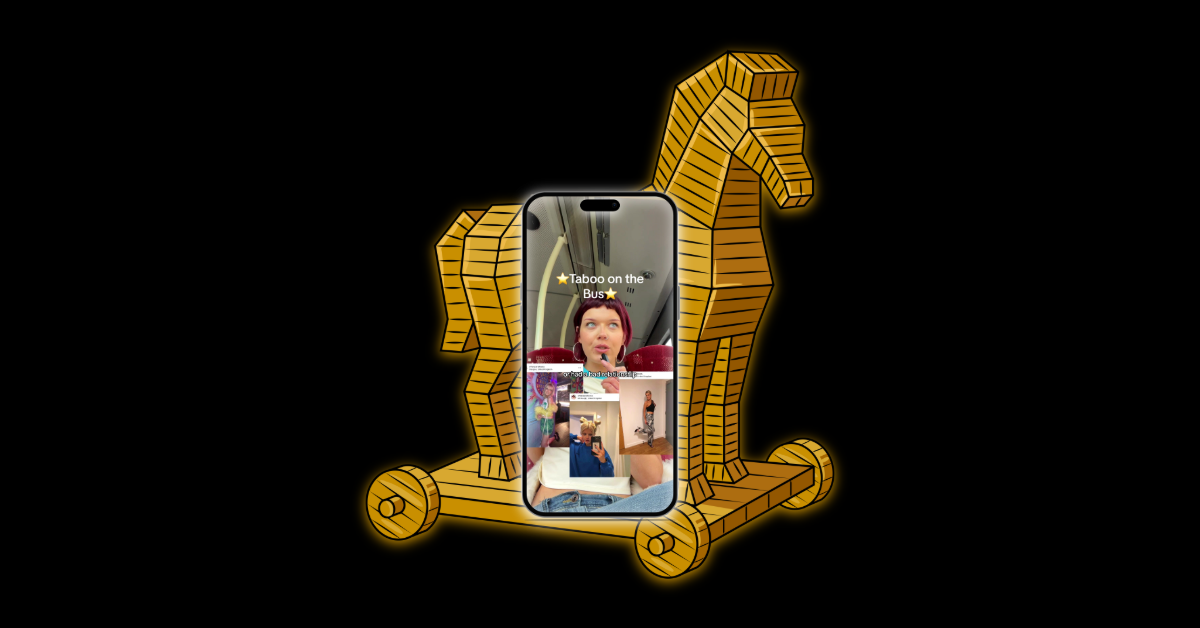
The trojan horse in the feed: hacking the digital circus
I’ve recently noticed a delicious irony unfolding on my timelines and I simply cannot get enough.
While the algorithm continues its relentless pursuit of "mindless" engagement, a new wave of creators is using those very mechanics to stage somewhat of a coup.
Creators like my personal fave @whatzaraloves have mastered a specific kind of digital alchemy. They take the "low-brow" aesthetics of social media, the shaky, lo-fi "talking head" video recorded on a noisy commute, and use it as a Trojan Horse to deliver high-level cultural theory and critique.
It is meta-media at its finest: using the digital spectacle itself to explain exactly why the performance is broken.
The talking head hack
The algorithm, just like myself, is a creature of habit. It has been trained to reward "relatable", face-to-camera content because it mimics the intimacy of a FaceTime call. Usually, this format is reserved for "get ready with me" routines or random life updates.
But these creators are hacking that intimacy, and it’s genius. Because, we know now, that if you look like you’re just crashing out about a bad day, the algorithm will push you into the feeds of millions. And it’s only once the viewer is 2 minutes deep that they realise they aren't even watching a vent session, but attending a lecture on late-stage capitalism, the commodification of the female gaze, or the sociological rot of micro-trends.
The meta medium irony
There is something soooo deeply satisfying about watching a critique of digital culture on the platform being critiqued. It just scratches an itch in my brain that feels almost ancient.
- The medium: A platform designed to keep you scrolling in a dopamine-loop of "pretty" distraction.
- The message: A rigorous deconstruction of why that loop is killing our attention spans and our self-worth.
By delivering sociology through the medium of a "commuter vlog", these creators are reaching people who would likely never step foot in a lecture about postmodern feminism in the digital age or pick up a theory book on anything like it.
They're democratising critique by disguising it as content. Not influencing, but interfering.
From aspiration to articulation
For a long time, the social media woman has been expected to provide aspiration, the "What I Eat In A Day" lies and the polished aesthetic I’ve written about before. This new wave replaces aspiration with articulation.
The "goals!" in the comment section of a @whatzaraloves video isn't about her waistline or her outfit; it’s about her clout of mind. I’m not following because I care about what she buys (even though she does look cute always); I’m there to learn how to see through what I’m being sold. It is a shift from being a "consumer of the spectacle" to being an "analyst of the spectacle."
Dismantling the spectacle from the inside
We often talk about social media as a "passive" experience, a digital "bread and circuses" designed to keep us numb. But these creators are proof that the circus can be hijacked.
The algorithm doesn't have to be a one-way street of brain-rot, you can use the engine of the machine to throw a wrench in the gears.