The disappearing act: A eulogy for the visible woman
There’s a deep grief I currently feel that overwhelms me every time I scroll social media.
It’s a grief that comes with watching a harvest you thought was over begin all over again. For those of us who came of age in the 2010s, we were told the era of the "vanishing woman" was a relic of the nineties, the dark, heroin chic chapter we thought we had finally closed. We were promised a future where taking up space was a form of power.
But looking at my screen today, it’s clear the industry was just waiting for the wind to change. The harvest is back, and this time, it’s clinical, algorithmic, and devastatingly efficient.
The Hunger Games of the red carpet
Nothing has made this mass disappearance more visceral for me than the recent public appearances of the Euphoria cast.
A few years ago, these women were the literal cultural blueprint for a new generation’s confidence. They represented a kaleidoscope of modern beauty: vibrant, healthy, unique.
Today, seeing them gathered on a red carpet feels less like a reunion and more like a scene from the Hunger Games. From Alexa Demie’s radically angular silhouette to the gaunt appearances of Zendaya and Hunter Schafer, the visual shift is genuinely shocking.
I cannot stress this enough: we are watching women wither away into skeletons of their former selves while the world screams "GOALS!" in the comments section. It is a collective delusion where we are taught to applaud the visible signs of a body under siege, rewarding the literal erasure of the very women who once told us it was okay to exist.
Prettiness as a perpetual prison
This is what Heidi N. Moore calls "self-disfigurement". She describes prettiness not as an asset, but as a "perpetual prison", a state where one’s value is constantly scanned for its eligibility for exploitation:
“Being untethered from the body for so long, seeing the body only as a vehicle to and for others, leads to self-disfigurement.”
When we consume a "What I Eat In A Day" vlog knowing damn well the creator is surviving on iced coffee and air, we are witnessing this "untethering" in real-time. These influencers are providing a maintenance manual for a product, their bodies have ceased to be homes, they have become billboards. To keep the billboard profitable, they must strip away the "excess" of their own humanity, their hunger, their energy, their softness, until only the "marketable" frame remains.
The betrayal of the "body positive" era
The weight of this grief stems from the sense of betrayal.
Don’t get me wrong, I don’t believe in the glorification of unhealthy living or anything like that. But we were led to believe that Barbie Ferreira’s Kat Hernandez was a turning point. She was a protagonist whose desirability wasn't a plot point to be resolved through a makeover.
But the industry’s patience for "space-taking" women was thin. Ferreira’s departure from the show, amid rumours that the production had no interest in evolving a "fully fleshed-out" character of her size, felt like a door slamming shut. Now, seeing the dramatic weight loss of nearly every woman associated with that "inclusive" era, the message is loud and clear: Body positivity was a trend to be profited from, but thinness is the law.
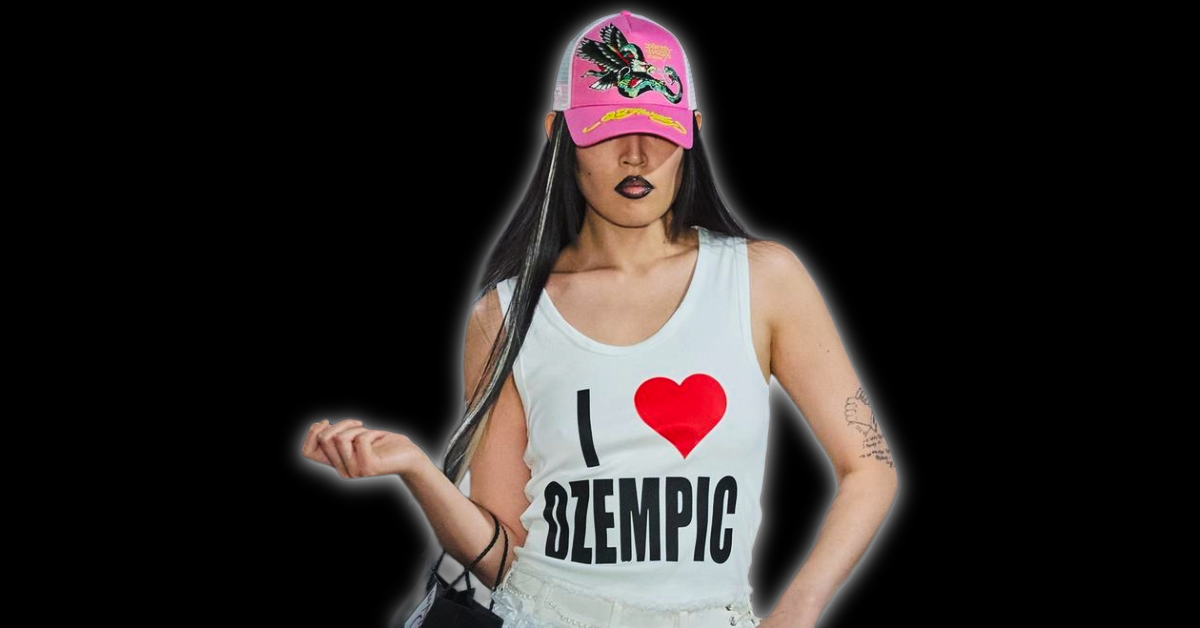
The industry didn't change its mind; it just waited for a pharmaceutical shortcut (cough, Ozempic) to make the "thin ideal" hyper-attainable again.
The algorithm of atrophy
This isn't just happening in Hollywood, it’s being reinforced by an algorithm of atrophy.
Marketing and social media platforms have placed a "tax" on visibility. To stay at the top of a feed, you must occupy less physical space.
- The commercialisation of gauntness: We are now in a cycle where even the side effects of rapid weight loss, hollowed eyes and sagging skin, are being commodified. The "Ozempic Face" is the new luxury accessory, sparking a gold rush for fillers and "reconstructive" aesthetics.
- The digital reward: The more "hollowed out" a creator appears, the more the algorithm pushes their content. It signals to every scrolling girl that the fastest way to be "seen" is to become as close to invisible as possible.
It really has me questioning myself every single day: can I do this content thing if I don’t look like that? I’m not sure I want to know the answer.
The industrial harvest
We are witnessing a seasonal harvest of the female form. The industry waits for us to get comfortable in our skin, then shifts the standard to "fragility" to resell us the cure for the "problem" they just invented.
It is a unique, heavy sorrow to watch a new generation of women fall into the same trap that their mothers just finished unlearning. We lived through the 90s, the 2000s, and now the 2020s, era upon era of being told that our "usefulness" is inversely proportional to our weight.
We are being told to clap for a disappearing act. But believe me, there is no magic here.
There is only the crushing grief of watching women choose to be "useful" skeletons over whole, untethered human beings. The industry is full. But we are starving.