Whenever I think of how much of an influence fashion has on literally everybody’s daily choices, I think of the cerulean monologue from The Devil Wears Prada.
“That blue represents millions of dollars of countless jobs, and it’s sort of comical how you think that you’ve made a choice that exempts you from the fashion industry when, in fact, you’re wearing a sweater that was selected for you by the people in this room… from a pile of 'stuff.'”
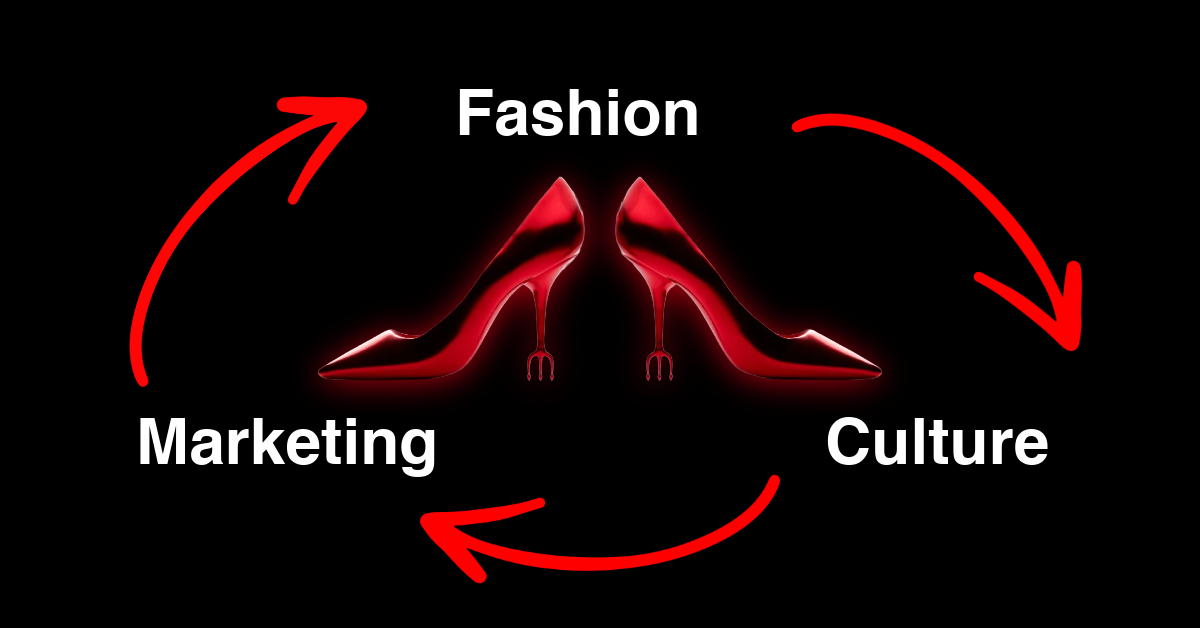
You see, fashion creates culture.
Culture is shaped by marketing.
And marketing sells belonging.
The three feed into each other in an endless loop where clothing becomes cultural expression, and cultural expression becomes profitable lifestyle.
It's a feedback loop where nobody's really sure what came first.
Brands figured out they're not in the business of selling products. They're selling identity, aspiration. And it's working so well that we've all become willing participants in our own commodification.
Culture sets the terms before marketing ever gets involved.
What's cool, what's cringe, what signals your part of the in-group - all of that gets decided culturally. Fashion then becomes the physical manifestation of it.
There are some brands that build entire identities around shared cultural references. It’s at the point where the actual products almost don't matter, but instead, the recognition - this brand understands me, my community, speaks my language. When a brand uses your slang, references your inside jokes, understands your specific experience, it stops feeling like a transaction and starts feeling like belonging.
And brands have to stay constantly tuned in to what's happening culturally or they fade into the ether.
A brand that doesn't respond to the current music, memes, political moment, social shifts, is basically dead in the water.
Doesn't matter how good the quality is if nobody culturally cares anymore.
Marketing is the translation layer. It takes abstract cultural moments and turns them into visual stories, brand identities, shareable content that makes you want to participate. You're not buying a jacket - you're buying into an aesthetic, a vibe, a version of yourself you've been sold through Instagram grids and TikTok trends.
Social media collapsed the distance between seeing something cool and being able to buy it immediately.
Brands build entire worlds you can inhabit digitally before you ever buy anything physically. The marketing becomes entertainment, aspiration, community.
And somewhere in there you click checkout.
The smart brands figured out that people trust their friends more than they trust ads, so they turned their customers into the marketing. Influencers, sure. But also just regular people posting their outfits, tagging brands, creating content that spreads way further than paid campaigns generally do.
User-generated content doesn't feel like advertising even though that's exactly what it is.
Fashion is where all of this lands.
The actual physical items you wear become social indicators. They communicate your personality, your status, which communities you belong to and what you value.
Trends move so fast now that by the time a traditional marketing campaign launches, the cultural moment has already passed. This is why brands try to move at the speed of culture but often fall flat on their face in the pursuit. Responding to memes in real-time, adopting emerging aesthetics while they're still underground, just for it to change again in a weeks’ time.
And increasingly, what you wear has to signal you care about the right things.
Sustainability is no longer optional for a lot of consumers - it's a baseline expectation. Same with size inclusivity, ethical production, fair labour. These aren't just nice little brand values, they're cultural requirements. If your brand doesn't address them, whole segments of your potential audience will reject you on principle.
What makes this particularly insane is how fast the loop moves now.
A meme becomes an aesthetic becomes a product line becomes mainstream culture in weeks. Something that used to take years to trickle down from runway to mall now happens before the runway show even ends.
Brands that wait for market research and approval workflows also have their issues.
By the time they've had meetings about whether to participate in a trend, the trend is over and everyone's moved on. The brands winning are the ones identifying cultural shifts early and responding authentically before it becomes obvious to everyone else.
Culture moves fast. And the marketing that wins is the marketing that moves with it without feeling forced or calculated.
What does it all mean?
You can't buy your way into cultural relevance.
Throwing money at advertising doesn't work when people can smell inauthenticity from a mile away. You have to actually understand the culture you're trying to reach, respect it enough to represent it honestly, and move fast enough to participate in cultural moments while they're happening.
Brands that feel like they're part of culture rather than trying to sell to it are the ones people actually want to wear and talk about. That requires genuinely caring about the communities you serve instead of just seeing them as target demographics. It requires letting culture lead instead of trying to force your brand narrative onto people who are already three steps ahead of you.
The key is to create something so timeless; it’s symbiotic with culture.
The brands that have done this for decades – Calvin Klein, Loewe, Balenciaga, MSCHF, are the ones that remain dominant in the space.
Most brands still don't get this. They're still operating like fashion is about the clothes. Like marketing is about the message. Like culture is something to extract value from rather than something to participate in authentically.
The brands that survive are the ones that understand they're in the culture business, not the clothing business.
The product is just the physical artifact of cultural participation. What you're really selling is the feeling of belonging to something that matters.
Once you see the loop, you realise nobody's really in control of it. Culture shapes fashion shapes marketing shapes culture.
We're all just riding it, hoping we don't get left behind when the next turn happens.
-Sophie Randell, Writer